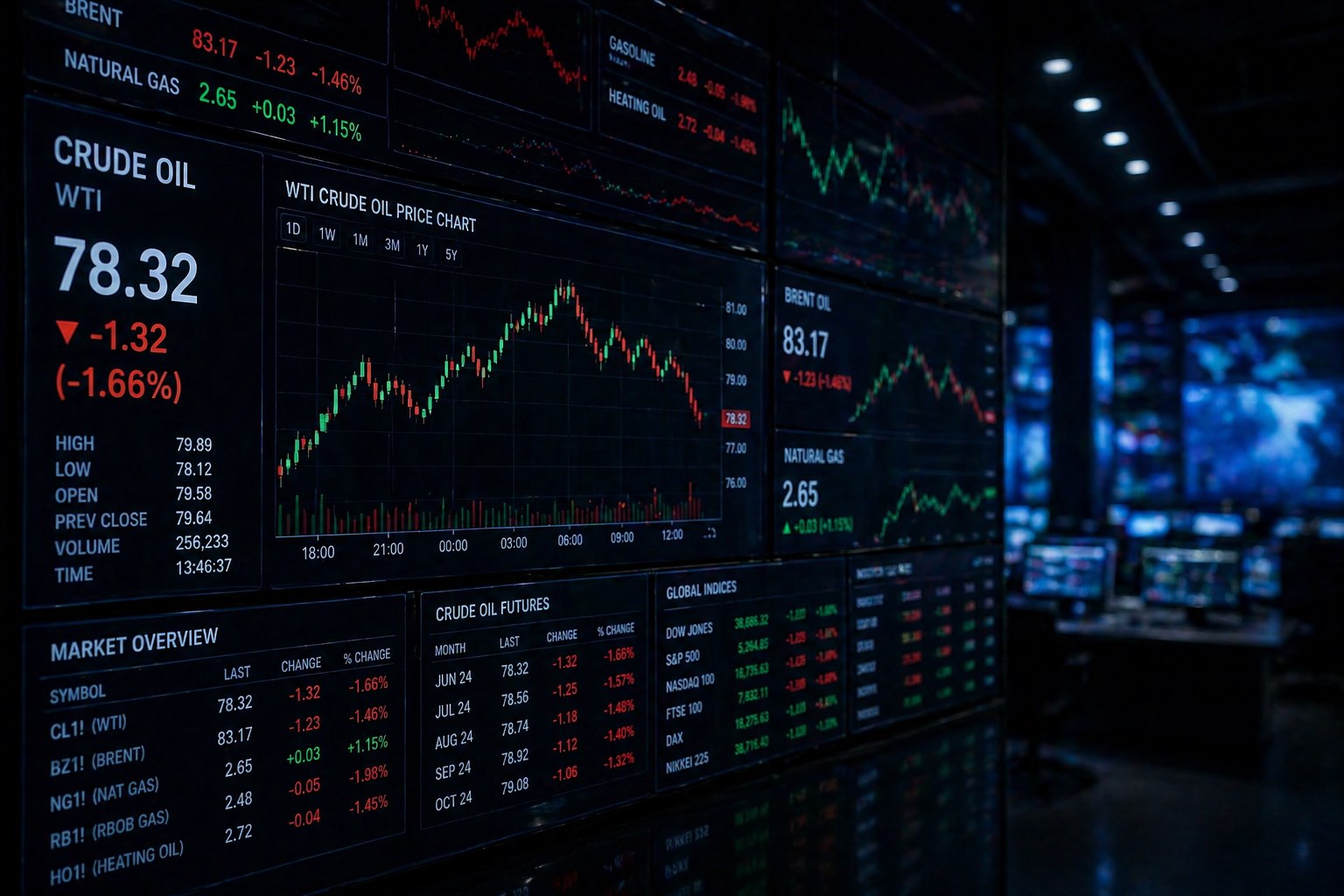
A barrel of oil cost about $3.18 in 1970. During the 2026 Strait of Hormuz crisis, Brent crude traded as high as $111 a barrel. That nominal increase looks dramatic until you adjust for inflation. The 1970 price of $3.18 is roughly $26 in 2026 dollars. The real change is closer to fourfold than thirtyfold.
What the headline numbers do capture, even without adjustment, is the pattern: oil prices move in long quiet stretches punctuated by violent shocks. Roughly one major shock per decade since 1973. Each one looks unprecedented at the time. Most of them turn out to be a variant of the same handful of structural pressures.
This piece walks through the major moves since 1970, what caused each one, and what the inflation-adjusted comparisons tell you about whether current prices are high, low, or unremarkable.
The Setup: 1970, 1973
Oil sold for under $4 per barrel through most of the 1960s and into 1970. The price was set not by markets but by a cartel of seven Western oil companies that controlled production, refining, and distribution across most of the producing world. OPEC existed since 1960 but had limited pricing power. Domestic US production was at its peak, and the world was awash in cheap, predictable energy.
That world ended in October 1973.
1973: The Embargo
The Arab members of OPEC imposed an oil embargo on the United States and several allied countries during the Yom Kippur War. Prices quadrupled within months, from around $3 to roughly $12 per barrel. The shock triggered gasoline rationing in the United States, long lines at filling stations, and a recession that lasted into 1975.
In 2026 dollars, that $12 peak is roughly $80 per barrel. The 1973 spike is often remembered as a record price, but in real terms it sits below current levels.
The embargo also created two institutions that still shape oil markets: the International Energy Agency, founded in 1974 to coordinate energy security among consuming nations, and the US Strategic Petroleum Reserve, established in 1975 to insulate the US economy from future supply shocks.
1979: Iran
The Iranian Revolution in early 1979 took Iranian production offline. Saudi Arabia and other producers offset some of the loss, but the panic premium was severe. Brent peaked around $36 per barrel in 1980. In 2026 dollars, that is approximately $160 per barrel.
That figure is worth pausing on. The 1979, 80 peak, adjusted for inflation, is higher than anything the world has seen since, including 2008. When people talk about oil being "expensive" today, they are talking about a price that is materially below the real cost of oil in the early 1980s.
1986: The Saudi Counter-Strike
By the mid-1980s, high prices had triggered the predictable response: new production from the North Sea, Alaska, Mexico, and elsewhere. OPEC's market share collapsed. In late 1985, Saudi Arabia abandoned its swing-producer role and flooded the market with crude. Prices dropped from roughly $30 to under $10 within months.
The 1986 crash crushed US producers and the Texas economy, contributing to the savings and loan crisis. It also established a pattern that has repeated multiple times since: Saudi Arabia uses price wars to defend market share against higher-cost producers, accepting short-term pain for long-term position.
1990 and 1998: Quick Shocks
Iraq's invasion of Kuwait in August 1990 pushed Brent briefly above $40 per barrel. The shock was short-lived: coalition forces restored Kuwaiti production within months, and prices fell back below $20 by mid-1991.
The Asian financial crisis of 1997-98 produced the opposite shock. Asian demand contracted sharply. Brent fell below $11 in late 1998, one of the lowest real prices in modern history. That period of cheap oil was a major contributor to the SUV-dominated US auto market of the early 2000s and to the underinvestment in upstream capacity that set the stage for the next spike.
2008: The Bubble
Brent reached $147.50 on July 11, 2008. That remains the all-time nominal record. In 2026 dollars, it is approximately $210 per barrel.
The causes were structural and speculative in roughly equal measure. Chinese demand was growing at unprecedented rates. Conventional production was struggling to keep up. Geopolitical premiums on Iran, Nigeria, and Venezuela were elevated. And commodity funds were taking large long positions in oil futures, amplifying the move.
The crash that followed was as dramatic as the rise. The global financial crisis collapsed demand. Brent fell from $147 to under $40 by December 2008, a decline of more than 70% in six months. It took five years to recover above $100.
2014, 2016: Shale and the OPEC Market Share War
The US shale boom of 2010, 2014 added several million barrels per day of new supply at production costs that were sometimes below $50 per barrel. By late 2014, with global growth slowing, OPEC faced the choice it had faced in 1985: cut production to defend prices and lose market share, or pump to defend market share and accept lower prices.
Saudi Arabia chose the latter. Brent fell from $115 in June 2014 to under $30 in early 2016. Many shale producers went bankrupt. Those that survived emerged with much lower break-even costs. The result was a new floor under US supply that reshaped global markets for the rest of the decade.
2020: Negative Prices
The COVID-19 pandemic produced the most dramatic short-term move in oil price history. With global demand falling by roughly 25 million barrels per day at the worst point and storage filling rapidly, the May 2020 WTI futures contract closed at minus $37.63 per barrel on April 20, 2020. Producers were paying buyers to take delivery because there was physically no place to put the oil.
Brent did not go negative, but it touched $19 per barrel that same month. The Saudi-Russia price war that briefly preceded the demand collapse made the move worse. Production was being expanded into a market that was disappearing.
The recovery from the 2020 trough was the fastest in oil history. By March 2022, Brent was back above $130.
2022: Russia
The Russian invasion of Ukraine in February 2022 pushed Brent to $139 within a week. The peak premium was driven by uncertainty about whether Russian crude would be effectively sanctioned out of global markets. In practice, Russian oil was redirected to India and China rather than removed from circulation, and the price gradually settled into the $80, $100 range for the next two years.
That period of relative calm, call it 2023 through early 2025, was where many recent market participants formed their priors about "normal" oil prices.
2026: Hormuz
Brent reached $111 in May 2026, the highest level since 2022, on the closure of the Strait of Hormuz following the Iran-US-Israel conflict. That figure is below the 2022 Russia peak, below the 2008 nominal peak, and well below the 1979 inflation-adjusted peak.
What was unusual about the 2026 episode was the duration. The 1973 embargo lasted five months. The 1990 Iraq shock lasted about six weeks. The 2022 Russia spike's worst phase lasted roughly two months. The Hormuz closure constrained supply for more than three months before a US-Iran agreement put the strait on a path to reopening.
For inflation context: the 2026 peak of $111 equals roughly $111 in 2026 dollars (no adjustment needed). The 1980 peak of $36 equals roughly $160 in 2026 dollars. The 2008 peak of $147 equals roughly $210 in 2026 dollars. By the real-terms measure that economists prefer, even the 2026 peak was elevated but not historically extreme.
What the Pattern Tells You
A few things stand out across 55 years of prices.
Oil shocks happen roughly once a decade, sometimes twice. The drivers rotate (cartel action, war, financial crisis, pandemic), but the cadence is remarkably consistent. Anyone planning for steady prices over a 10-year horizon is planning for a scenario that has not happened once in modern history.
The crashes are usually larger and faster than the spikes. The 1986 crash, the 2008 crash, the 2014, 16 crash, and the 2020 crash all moved further and faster than the upmoves that preceded them. High prices reliably draw out new supply or destroy enough demand to break themselves. Low prices reliably under-fund the next supply cycle, setting up the next spike.
Inflation-adjusted prices have been remarkably stable across the long term. Excluding the 1979 and 2008 peaks, real oil prices have spent most of the last 50 years in a band between $30 and $80 in 2026 dollars. Current prices in the $95, $110 range are toward the top of that band but not outside historical norms.
And finally, every shock has been called unprecedented in the moment. The 2026 Hormuz crisis is the latest entry in a long series of episodes that each looked uniquely catastrophic at the time. Most resolved within 6 to 18 months. Some left structural changes (the SPR, the IEA, US shale, the post-2014 supply curve) that shaped markets for decades afterward.
The question worth asking about the 2026 oil shock is not whether prices are high. The question is what structural change it leaves behind when it ends.
This article is for informational purposes only and does not constitute financial or investment advice. Oil market conditions can change rapidly. Inflation adjustments use US CPI data through April 2026.