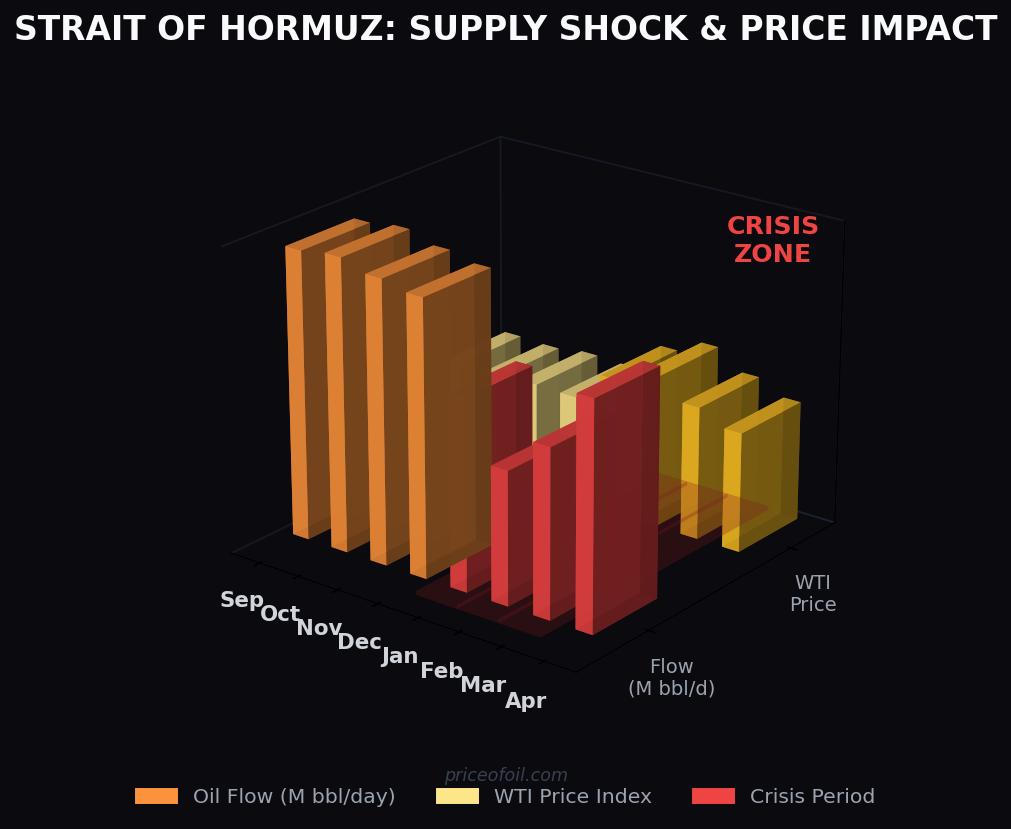
The Strait of Hormuz is 33 kilometers wide at its narrowest point. Through it move roughly 20 million barrels of oil a day, about one in every five barrels consumed on Earth. In 2026 that single waterway became the most important variable in the global oil market, and it has stayed there through a spike, a ceasefire, a collapse, and a war that has now spread beyond Iran. This is the arc of the crisis and what drives the price at each stage.
How It Started
On March 4, 2026, Iran declared the Strait of Hormuz effectively closed to Western-allied shipping after US and Israeli airstrikes on Iranian military and nuclear sites. Within days, Brent crude passed $100 a barrel for the first time in four years, and the International Energy Agency announced the largest emergency reserve release in its history. By April, Brent had reached roughly $126, its highest in years, as tanker traffic through the strait collapsed and a $40 war premium built into every barrel.
The mechanism is simple and brutal. No pipeline, road, or alternative sea route can replace Hormuz. Saudi and Emirati bypass pipelines to the Red Sea and the Gulf of Oman carry only a fraction of the volume that normally transits the strait. When the passage is threatened, most of that oil has nowhere to go, and the price reflects it almost instantly.
The June Ceasefire
In June, after months of intermittent fighting and repeated closures, the US and Iran signed an interim framework meant to end the war and reopen the strait. The US agreed to waive oil sanctions and unfreeze assets; Iran agreed to keep Hormuz open for a 60-day window while a final deal was negotiated. Tanker traffic began to resume, Gulf producers ramped exports, and the market exhaled. Brent fell below $80 and kept sliding toward $70 by early July, back near its pre-crisis level. The $40 war premium that had defined four months evaporated, because a risk premium is an expectation, not a physical shortfall, and it fades the moment fear does.
For a few weeks the forecasting question flipped from how high to how far down.
The Collapse
It did not hold. On July 8 the fighting resumed. Commercial ships were attacked in the strait, the US struck dozens of Iranian military targets, and President Trump declared the ceasefire over and pulled the waiver that had let Iran sell its oil. Iran again declared the strait closed and later suspended its commitments under the agreement outright. The interim framework, meant to produce a final deal by mid-August, was left in tatters.
The War Widened Beyond Iran
The phase that began in mid-July is different in kind from what came before, and it is the reason the price has moved again.
The US reinstated a naval blockade of Iranian vessels transiting the strait and began enforcing it, disabling an empty tanker with missiles as it approached Kharg Island to load. American strikes ran thirteen consecutive nights from July 11, hitting command centers, air defenses, port infrastructure at Bandar Abbas, and missile and drone sites tied to Iran's ability to attack shipping. On July 22 Trump threatened to bomb one bridge or power plant for every Iranian attack on a ship in Hormuz, a threat that was never carried out. Iran retaliated across the Gulf, striking US positions and partners in Kuwait, Bahrain, Jordan, Qatar, and Syria.
Three developments crossed lines the war had previously respected. On July 18, Kuwait Petroleum Corporation confirmed that one of its oil facilities was hit in Iranian attacks, causing significant material damage and injuries, alongside fires at power generation and water desalination plants and a strike on the country's airport. That is the first confirmed damage to the oil infrastructure of a Gulf producer other than Iran. Separately, Yemen's Houthis declared a naval blockade of Saudi Arabia on July 20, and on July 23 they acted on it: the Saudi-owned tanker Encelia was struck in the Red Sea, the first confirmed attack under the blockade, and at least seven vessels rerouted to avoid the passage. That opened a second chokepoint for real. Analysts estimate that closing Bab el-Mandeb would remove roughly 7% of global oil supply by blocking Saudi barrels routed through the Red Sea, compounding the Hormuz disruption rather than substituting for it.
Then, on July 25, the Houthis escalated from ships to the shore. Satellite imagery showed fires spreading at Saudi Aramco's Jizan refinery, and two ballistic missiles aimed at oil installations at Yanbu were intercepted by a Patriot battery operated by the Greek military. Neither Aramco nor the Saudi government published a damage assessment, so the extent of the harm at Jizan is unknown and Houthi claims about it are unverified. The target selection is what matters. Yanbu is Saudi Arabia's principal Red Sea export gateway and has averaged roughly 3.75 million barrels a day since this crisis began. It is the route around Hormuz. Attacking the bypass is a different order of threat from attacking a tanker, because it goes at the market's fallback rather than its main artery.
The shipping data shows how thoroughly the strait has emptied. Only eight ships transited on July 16, the lowest count in three weeks, against a peacetime norm near 130 a day. War-risk insurance now runs 7.5% to 10% of hull value against roughly 0.25% before the war, quoted by Marsh on July 22, which means a $100 million tanker pays several million dollars for a single passage. Those are quoted rates: owners often negotiate large no-claims discounts, and what is actually paid is lower and is not published.
The Pause That Broke
The escalation stopped as abruptly as it started. Brent crossed $100 on July 23, settling at $100.69, its first close above that line since May. Then, late on July 24, the United States quietly stopped bombing Iran. There was no announcement and no declared truce; the campaign simply ended after thirteen nights. Iran reciprocated, with its army spokesman confirming the mutual halt on state television.
Behind the quiet was an Omani channel. Omani officials travelled to Tehran, and Iranian and Omani deputy foreign ministers met there to negotiate safe passage through the strait. Oil gave the whole breakout back: Brent fell to $84.09 by July 28, a three-day collapse of about 16%.
The pause lasted four nights.
What Oman Offered and What Iran Demanded
The terms became public in the last week of July, and the gap between them is the reason this is not close to resolved.
Oman proposed managing Hormuz as a joint regional waterway on the model of the Strait of Malacca: the transit route split evenly between Iranian and Omani territorial waters, each side managing its own half, funded by voluntary contributions rather than mandatory tolls. The Malacca arrangement it is modelled on raises something like $70 million a year.
Iran rejected it. Deputy Foreign Minister Kazem Gharibabadi went on state television and called an even split unreasonable. Tehran's counter-proposal puts one route entirely inside Iranian territorial waters plus part of the opposite lane, which would give it oversight of traffic in both directions, and it is reported to be seeking a service fee of $1 million per ship. That is not a variation on the Malacca model; it is roughly an order of magnitude beyond it. Iran also said it will not permit any third country to clear mines from the strait, even at Oman's invitation, and that if Oman refuses, the strait stays closed.
Gharibabadi's summary is the line worth remembering: the strait "will never return to its pre-war state." Oman has since floated a three-route alternative with Iranian, international and Omani lanes. Iran has not publicly responded to it.
The War Resumed, and the Target List Changed
On the evening of July 28, Iran's Revolutionary Guard fired ballistic missiles at US forces in Jordan, targeting an air base and Central Command's forward headquarters. Every missile was intercepted and there were no US casualties. President Trump promised on television that Iran would "get a beating."
It arrived on the night of July 29. Central Command carried out a two-hour wave against dozens of Revolutionary Guard targets, and the target list is the most important development of this phase: military command centres, missile and drone facilities, coastal surveillance and defence sites, and what the statement called maritime capabilities, struck along the Gulf shoreline at Qeshm, Kish, Bandar Abbas, Abu Musa, Bushehr, Abadan, Ahvaz, Kazerun and Farashband.
That is not a campaign against Tehran or the nuclear programme. It is a campaign against Iran's physical ability to hold the strait. As of July 31 it had not been repeated, so the pattern is punctuated rather than sustained.
Iran's answer has gone sideways rather than up. A strike on a Chinese company's building in northern Kuwait killed one worker, Jordan downed five more Iranian missiles, and Iran's army claimed drone attacks on two Kuwaiti air bases. Analysts describe this as horizontal escalation, widening the geography instead of raising the intensity.
A Third Front, in the Mediterranean
On July 29 a drone struck two vessels at Damietta, Egypt's Mediterranean LNG hub: the American-owned floating regasification unit Energos Winter and the LNG carrier GasLog Salem. Fire spread from one to the other. There were no casualties.
Egypt's cabinet confirmed a drone caused it. Nobody has claimed responsibility, the Houthis have denied involvement, and Iran has denied it as well. One US outlet reported two anonymous Iranian sources describing it as a demonstration of what Iran could do to global shipping, which remains single-sourced and denied.
Attribution aside, the significance is geographic. This is the first attack of the war on Egyptian soil and the first in the Mediterranean, and it landed on the route energy has been using to get around the Gulf.
Insurance Is Now Closing Routes the Missiles Have Not
On July 29 the Lloyd's and IUA Joint War Committee issued circular JWLA-034, which widened Saudi Arabia's entry in the London market's listed areas. Saudi Arabia was already listed before that. The previous circular, from March 3, carried two qualified entries covering the Gulf coast and the Red Sea coast excluding transits. JWLA-034 replaces both with a single unqualified listing.
The qualifiers are what mattered. The circular defines a named country to include its ports and coastal waters out to 12 nautical miles offshore unless specifically varied, so removing them puts the entire Saudi coastline inside a listed area on both seaboards, and ends the exemption for ships that pass the Red Sea coast without calling at a Saudi port. The same circular pushed the northwest boundary of the Gulf and Southern Red Sea area from 18 degrees north to south of latitude 25.5 degrees north, which pulls Jeddah, Rabigh, King Abdullah Port and the Yanbu oil terminal inside listed waters. It carved out Egyptian territorial waters, dated the same day Damietta was hit, dropped the southern limit on Eritrea, and removed Pakistan.
London market war risks policies carry a customary 72-hour notice period, so the widened Saudi listing bites from about August 1. Lloyd's insurers had already begun excluding vessels calling at Saudi ports from Red Sea cover. Insurance is doing what the missiles have not managed, which is closing routes by making them uninsurable.
Saudi Arabia's answer was to convene military chiefs from 43 countries and announce a multinational maritime coalition. Only 14 signed the declaration, and the alliance covers the Red Sea, Bab el-Mandeb and the Gulf of Aden rather than Hormuz. The chokepoint doing the most damage is the one it does not address.
Why the Price Is Not at $126 Again
Even at the July 23 peak above $100, oil never came close to the April high, and it has since round-tripped to $84.09 and back to about $90. Two things cap it.
The first is the surplus and the spare capacity behind it. OPEC+ has raised output for five straight months and holds more than 5 million barrels a day of spare capacity, with Saudi Arabia alone sitting on roughly 3 million, the most since 2009. Saudi Aramco cut its selling price to Asia by the most in decades. The catch, and it is the most important nuance of this phase, is that most of that spare capacity sits behind the same strait that is closing. A surplus stranded behind a chokepoint behaves like a shortage until the chokepoint clears, which is why prices can rise even while inventories and spare capacity look comfortable on paper.
The second is Kharg Island. No strike has hit the terminal that handles roughly 90% of Iran's crude exports, and flows are reported still running above 1.5 million barrels a day. President Trump has repeatedly floated seizing the island and has repeatedly not done it; his own account of the March strikes on Kharg's military sites included an instruction not to touch the oil. As long as the barrels keep loading, the disruption is about the route, not the source. A closed strait raises the cost and danger of moving oil; a burning export terminal would remove the oil itself. The market is pricing the first, not the second. See our explainer on Kharg Island for why that distinction is the whole difference between $90 and $120.
One caution for readers following this story elsewhere. On July 26 the US president posted an AI-generated image captioned "STRIKE ON KHARG," and several aggregators reported it as though it documented a real attack. It did not. The terminal has not been struck, has not been seized, and is still loading.
The Longer History
Iran has threatened to close Hormuz many times over three decades. In the Tanker War of the 1980s, Iran and Iraq attacked oil tankers transiting the Gulf, and the US eventually began escorting Kuwaiti tankers in 1987. Every time tensions escalate, the Hormuz premium spikes; every time the crisis passes, it recedes. What made 2026 different was the scope of the underlying conflict, a direct military confrontation rather than a sanctions standoff, and the fact that the strait is one of the clearest leverage points Iran holds.
What to Watch
Three triggers now sit in front of the price, and the market is tracking all of them at once.
Whether the negotiation restarts, and whether the strait actually reopens. The pause is over and Iran has rejected the only plan on the table, so the question is whether Oman's three-route idea gets a hearing or the strait becomes a permanent toll booth. A pause was never a reopening in any case: transit counts have run around 90% below the pre-war norm of roughly 130 a day, war-risk cover still runs as high as 7.5% to 10% of hull value, and the International Maritime Organization has advised ships to stay away until crew safety can be assured. If safe passage is ever agreed, the stranded spare capacity is waiting to pull prices back toward the $70s.
Kharg. A strike on or seizure of the terminal is still the supply shock the market has avoided, and it is still the difference between this price and a far higher one. Goldman Sachs has said that if Hormuz stays largely shut for another month, Brent averages above $100 for 2026, with $120 in the third quarter under severe restriction.
The second chokepoint, which is no longer a question. The open question of whether the Houthi campaign would be sustained was answered on July 25, when they moved from hitting a tanker to hitting Saudi oil infrastructure at Jizan and firing on Yanbu. A successful strike on Yanbu, rather than an interception, would take out the route that exists precisely to avoid Hormuz. That is the single most underpriced risk on this list, and war-risk insurance premiums can turn it into a real shortfall by making passage uneconomic even without another hit.
A note on the other direction. Not every input is bullish. Kazakhstan resumed exports through the Caspian Pipeline Consortium terminal on July 27 after a week-long shutdown caused by drone strikes on tankers, returning roughly 400,000 to 450,000 barrels a day that the market had written off.
What the Strait of Hormuz keeps demonstrating is that the global oil market is structurally dependent on one narrow, politically fragile passage. Every year without genuine alternative routing is a year in which a single decision in Tehran can move energy costs for every driver, farmer, and factory on Earth. That is the real story behind the price on the pump sign.
This article is for informational purposes only and does not constitute financial or investment advice. Oil market conditions can change rapidly. Consult a qualified financial professional before making investment decisions.