The beating Trump promised arrived at 10pm Eastern on Wednesday. It lasted about two hours, and the target list says more about where this war is going than anything said at a podium this week.
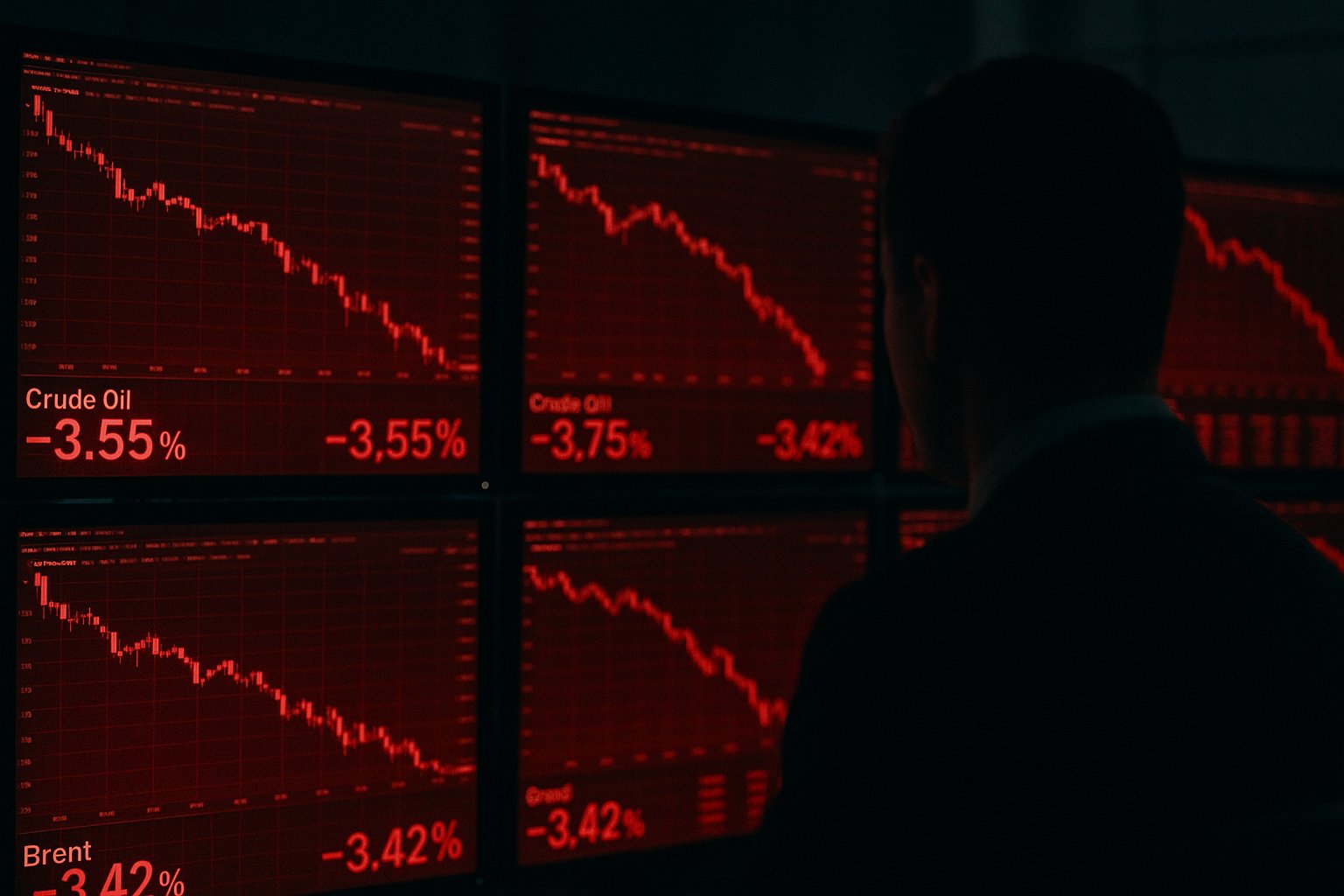
Brent crude traded near $89.32 a barrel on Thursday morning, down about 1.6%, with WTI near $83.32. That comes off Wednesday's settle of $90.74 for Brent, a gain of 7.91%, and $84.46 for WTI, up 6.56%. Wednesday was one of the sharpest single-day rallies of the war. Thursday is giving a piece of it back.
The Target List Was the Strait, Not the Regime
Central Command said it completed a heavy wave of strikes against Iran, finishing at 02:00 GMT. Dozens of Revolutionary Guard targets were hit: military command centers, missile and drone facilities, coastal surveillance and defense sites, and what the statement called maritime capabilities.
Read that list again. Coastal radar. Anti-ship missiles. Naval command. Iranian state media and correspondents on the ground reported hits on Qeshm Island, Kish Island, Bandar Abbas, Abu Musa, three cities in Bushehr province, Abadan and Ahvaz in Khuzestan, and Kazerun and Farashband in Fars.
That is a map of the Gulf shoreline. It is not a map of Tehran, and it is not the nuclear program. Washington's answer to Tuesday's missiles was a campaign against Iran's physical ability to hold the Strait of Hormuz.
Central Command framed it as reducing threats to American forces, commercial shipping, and neighboring Gulf nations. Iranian outlets report three civilians killed on Qeshm, a couple and their two-year-old child, plus three Revolutionary Guard personnel. Those casualty figures come from Iranian state media and have not been confirmed independently.
One caution on the counting. Different outlets are calling this the fourteenth night, the resumption after a five-night pause, or the continuation of a thirteen-day exchange. The safest description is the one that needs no arithmetic: these were the first US strikes on Iran in five nights.
Iran Answered Within Hours, and It Answered Sideways
Two responses landed Thursday morning, and neither was aimed at the United States directly.
An Iranian strike hit a Chinese company's building in northern Kuwait, severely damaging it and killing one worker. Kuwait's military confirmed it. Jordanian air defenses shot down five Iranian missiles, confirmed by the Jordanian armed forces and the Petra state agency, with no casualties.
The Revolutionary Guard put out a statement that reads as a thesis for the whole conflict: "The Strait of Hormuz is our territory, and the courageous forces of the IRGC Navy firmly control it." It warned that no party from thousands of kilometers away would be permitted to interfere, that the aggressor would be punished, and that countries assisting the United States would receive a harsh response. That last clause is a threat to the Gulf states hosting American aircraft.
A warning for anyone searching this today: reports circulating of Iranian attacks on Bahrain, Qatar and the UAE, and of ten ballistic missiles fired at Jordan's Al Azraq air base, are recycled stories from July 9 through July 19. Aggregators are stripping the dates. They are not Thursday's news.
The War Reached the Mediterranean
The most consequential energy story of the last day did not happen in the Gulf at all.
Overnight Wednesday, a drone struck vessels at Damietta, Egypt's Mediterranean LNG hub. The ships hit were the Energos Winter, an American-owned floating storage and regasification unit, and the LNG carrier GasLog Salem. Fire spread from one to the other. There were no casualties, the crews evacuated, and both vessels were moved offshore for damage assessment. Egypt's cabinet said an initial investigation found a drone caused the fire.
Nobody has claimed it. Iran has not claimed it, and Egypt has not attributed it. The New York Times reports two anonymous Iranian sources saying the operation was meant to demonstrate how badly Iran could disrupt global shipping and energy if it chose to. That is one outlet and two unnamed sources, and it is the only thread connecting Iran to the attack. Treat it as exactly that.
The significance does not depend on who did it. This is the first strike on Egyptian soil in this war and the first in the Mediterranean, and it landed on the precise route Gulf energy has been using to get around the Gulf. If Damietta can be hit, the detour is not a refuge.
One Tanker Got Out
Against all of that, the single most encouraging data point in weeks.
The QatarEnergy-controlled LNG carrier Al Areesh, loaded at Ras Laffan in early July, sailed out of the Strait of Hormuz overnight. It is the first QatarEnergy-controlled LNG tanker to exit since the Al Rekayyat was struck on July 7. Ship-tracking data shows it bound for Port Qasim in Pakistan. European gas fell below 60 euros per megawatt hour on the news.
That is one ship, and QatarEnergy's force majeure to European and Asian customers remains in force with roughly 14 tankers still waiting off Ras Laffan. But it is the first evidence in three weeks that the strait is not fully sealed.
The counter-signal came the same day. Iran's Revolutionary Guard claims it targeted and stopped three oil tankers in Hormuz on Wednesday, a claim carried by Tasnim that Gulf News explicitly could not verify. Roughly 14 vessels transited the strait on Wednesday against a pre-war norm near 138 a day. Crude moving through Hormuz is running about 6.5 million barrels a day against roughly 20 million normally.
Lloyd's Redrew the Map, and Saudi Arabia Is Now Inside It
Here is the development almost nobody covered, and it is documented rather than sourced to anonymous officials.
The Lloyd's and IUA Joint War Committee issued circular JWLA-034 on July 29, amending the listed areas for hull war, piracy and terrorism cover. Saudi Arabia is now a named country. Under the circular's own definitions, that means every Saudi port and its coastal waters out to 12 nautical miles sit inside a war-risk listed area.
The same circular redrew the northwestern boundary of the Gulf and Red Sea zone to exclude Egyptian territorial waters. That carve-out is dated the same day Damietta was hit.
Insurance is now doing what the missiles have not managed, which is closing routes by making them uninsurable. Lloyd's insurers had already suspended war-risk cover for Saudi-linked Red Sea vessels in late July, with Ascot and Navium moving to cancel existing policies. Freight is telling the same story: the VLCC Jamaica Prosperity was provisionally fixed at close to $500,000 a day for an August 3 Gulf loading. Gulf-origin barrels are where the premium has concentrated.
Why Oil Fell While the War Widened
The market is not reading any of the above as bullish, and the reasoning is coherent even if it turns out to be wrong.
Reuters attributes Thursday's decline to the Oman-Iran talks on managing the strait, to continued tanker movement, and to profit-taking after a near-8% day. Hamad Hussain of Capital Economics put it plainly: the fact that Oman is in talks with Iran could suggest progress is being made on reopening the strait. Thirty-nine commodity ships passed Bab el-Mandeb on Tuesday, the most since July 19, which offered reassurance that crude is still reaching buyers.
The other side of that trade has an equally clear spokesman. Tim Waterer of KCM Trade: until safe passage through Hormuz is no longer a gamble, the risk premium is not going anywhere.
What the tape actually says is that traders now believe the barrels are finding another way around. The war is spreading and the premium is draining at the same time, because routing beats blockading over a long enough horizon.
The Fed Held, and Blamed Energy
The Federal Reserve left its target range at 3.50% to 3.75% on Wednesday, a fifth consecutive hold. The vote was 9 to 3, and all three dissents were hawkish: Hammack, Kashkari and Logan wanted a 25 basis point hike.
The statement named energy directly, saying inflation remains elevated in part reflecting supply shocks including energy. Futures now price roughly 57% odds of a hike in September. The dollar weakened about 0.5% on the decision, which is oil-supportive, so the Fed is not what pushed crude lower on Thursday.
The bond market took it harder than equities. The 30-year Treasury yield reached 5.213%, the highest since 2007.
The Real Squeeze Is Diesel
Crude fell on Thursday. The refined product that actually matters to freight and farming got worse.
Goldman Sachs published Thursday that diesel sits at the epicenter of a fuels squeeze, with global refinery runs at their lowest seasonal level since the pandemic, cutting throughput an estimated 6.5 million barrels a day year over year. Russian and Middle Eastern outages plus subdued Chinese processing are the drivers. European diesel margins are at records, with the ICE gasoil crack above $70 a barrel.
American drivers can see the split at the pump. The national average for regular gasoline is $4.098 a gallon, up seven-tenths of a cent in a week. Diesel is $5.339, up 13 cents in a week and 48.6 cents in a month. Gasoline is flat while diesel climbs, and that gap is a refining story, not a crude story. Aramco's 400,000 barrel a day Jizan refinery has been down since July 27 with a tentative August 15 restart, and over half its June exports were diesel and gasoil.
The Inventory Picture, Confirmed
Wednesday's official EIA count for the week to July 24 has now been verified against the agency's own tables. Commercial crude fell 7.167 million barrels to 404.5 million, about 7% below the five-year average, against a Reuters poll expecting a draw of only 1.3 million.
The Strategic Petroleum Reserve fell 3.8 million barrels to 307.65 million, the lowest since March 1983 and an eighteenth consecutive weekly decline. Total US crude including the SPR is at its lowest since 1984. Cushing fell to 18.6 million barrels, the lowest since 2014, and refinery utilization ran at 97.2%.
Refiners are running flat out and still drawing down storage. That is the tight part of this market, and it is domestic.
What the Forecasters Still Have Not Done
Nobody revised anything. A 7.91% day produced no published forecast change from any of the nineteen institutions checked.
Goldman Sachs holds Brent at $80 for the fourth quarter, reaffirmed July 23. JPMorgan's July fair value is $87. Barclays carries the highest live base case at a 2026 average of $96, and it is worth correcting a number we have used: Barclays is at $96, not $100. The $100 figure was from May 1.
Half the apparent disagreement in the sell-side range is staleness rather than genuine dispute. Morgan Stanley's $75 dates from June 30 and Citi's $60 to $65 from July 3, both struck before the July 8 truce collapse and both resting on an assumption that Hormuz reopens. Counting only post-July-8 work, the range is Goldman $80, JPMorgan $87, Barclays $96, Rapidan near $100.
Two Corrections to Yesterday's Corrections
We owe readers two fixes, and both are fixes to things we published yesterday as corrections. Getting a number wrong is ordinary. Getting it wrong while announcing that we were setting it right deserves a plainer accounting.
The war-risk range
Yesterday we told readers that the 7.5% to 10% war-risk figure we had been using was a March number covering only US, UK and Israeli-linked vessels, and that the current broad market was 2% to 6% with about 5% as the norm. That was wrong, and it made the market look calmer than it is.
The 2% to 6% range is real, but it is dated. Marcus Baker, Marsh's global head of marine, cargo and logistics, gave it to Bloomberg on July 9, when rates had fallen back after the June truce. Baker then revised it twice as the fighting resumed: 3% to 10% on July 17, and 7.5% to 10% told to Platts on July 22, up from 1% to 3% a few weeks earlier. The number we called stale and the number we replaced it with came from the same broker. We corrected a live figure by pointing at its March namesake.
The March point was half right. Lloyd's List reported on March 11 that 7.5% to 10% applied to US, UK and Israeli-linked tonnage while ordinary tankers paid 0.8% to 1.5% and Hormuz transits 2.5% to 5%. What changed is that the whole market has since moved up to where sanctioned-nexus vessels sat in March. That tiering did not survive July. Lloyd's List reported on July 27 that quotes for a single very large crude carrier voyage had topped $10 million.
Two caveats readers should have. These are quoted rates, and owners often negotiate large no-claims discounts, so what is actually paid is lower and is not published. And this market is opaque: there is no exchange and no index, nearly every public percentage traces to one broker, and two tankers crossing on the same day can be quoted very different numbers depending on flag, ownership and whether they have called at a Saudi port. Our pre-conflict baseline of 0.15% to 0.25% was correct.
The Kharg queue
Yesterday this site also reported that vessel tracking showed just two stationary dark tankers in the waiting area off Kharg Island, and that the queue had drained through June. That was drawn from a single Windward report dated July 28 describing a narrow persistence count, and presenting it as the size of the queue was wrong.
The queue did not drain. Windward logged roughly 23 vessels in the offshore waiting area on June 13 and 14. Its July 26 collection counted 24 dark tankers in the eastern waiting area. United Against Nuclear Iran counted at least 23 in satellite imagery from July 25, at least 15 of them laden. Two trackers, separate methods, both dated late July.
What has actually been true since early May is duller than either number suggests: the queue has sat in the high teens to mid twenties continuously. Windward itself describes 24 as sitting inside the 16 to 24 band logged across prior collections. It is not a spike, and it never collapsed.
The part of Wednesday's account that holds up is the loading halt, and it is the more important half. Windward observed all Kharg terminals empty on July 26, and both the eastern and western terminals confirmed empty on July 27, with only an LPG arrival and arrivals there thinning. Compare July 7, when all three berths were working and three very large crude carriers loaded around 6 million barrels. Kpler put May crude loadings at 260,000 barrels a day against a trailing-year norm near 1.65 million, an 85% collapse. The United States reinstated the naval blockade on July 14.
So the accurate picture is a large, stable queue of laden and empty tankers sitting off a terminal that has largely stopped loading. Readers should also know these are four and five day old observations. No tracker has published a Kharg count for July 28, 29 or 30.
Abqaiq, For the Third Time This Week
The claim that Aramco has halted Abqaiq and taken roughly 7 million barrels a day offline is still spreading. It is carried by crypto blogs, content farms, a mineral-exploration company's news page, and an anonymous social account posting satellite claims.
No wire service confirms it. Saudi authorities say the drones aimed at Eastern Province facilities were intercepted. An outage of 7 million barrels a day would be the largest supply event in history, and it would not be sitting quietly on aggregator sites while Brent falls.
A related tell: an Argus headline about Riyadh disclosing damage to Aramco facilities is being passed around as current. It is dated April 26 and covers the East-West Pipeline, Manifa and Khurais. It is three months old.
What to Watch
Whether Wednesday's strike package gets a sequel is the question. A campaign aimed at coastal radar and anti-ship missiles has a military logic that a campaign against Tehran does not: it is trying to physically break Iran's ability to close the strait rather than to compel a decision. That kind of campaign tends to run until the target set is exhausted.
Watch whether a second LNG carrier follows the Al Areesh out, because one ship is an anecdote and three is a trend. Watch Oman's three-route proposal, which its own diplomats are still shopping. And watch whether the Damietta strike repeats, because the Mediterranean was the part of the map that still worked.
Kharg Island's export terminal has still not been struck, and after Wednesday's target list that is worth restating. Washington spent two hours hitting Iran's coastal radar and anti-ship missiles and left the terminal that handles about 90% of Iranian crude exports alone. That remains the difference between this price and a much worse one.
This article is for informational purposes only and does not constitute financial or investment advice. Oil market conditions can change rapidly. Consult a qualified financial professional before making investment decisions.