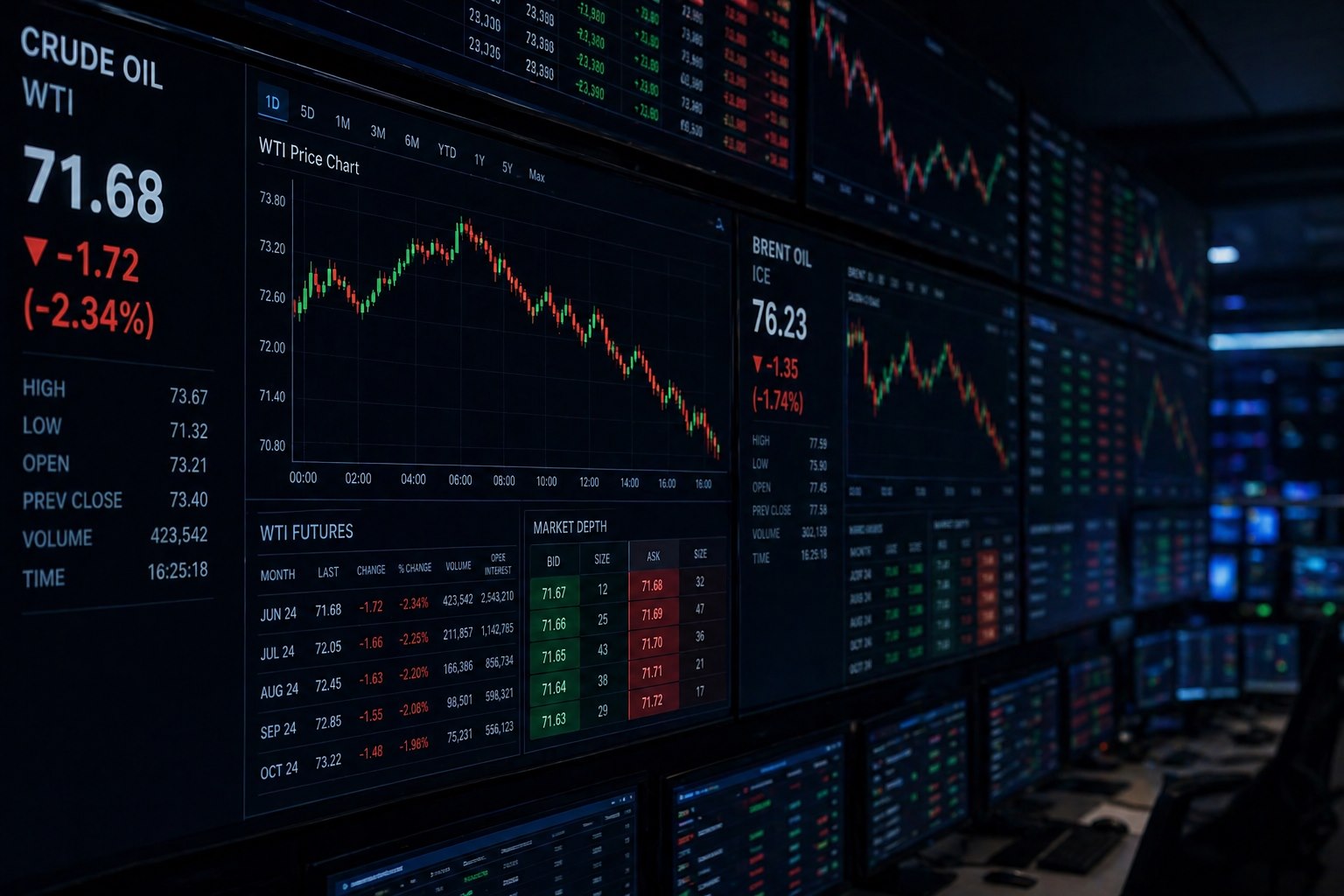
In early 2026, Brent crude traded near $70 a barrel. Within weeks of the Strait of Hormuz closing, it reached $111. By late June, after a US-Iran framework was signed and the strait began reopening, it had fallen all the way back to roughly where it started, near $70, erasing the entire run. The strait was still physically clearing when the premium vanished, so the barrels were not the story. The risk premium was.
The risk premium is one of the most important and least understood components of an oil price. It is the part of the price that reflects what the market fears might happen to supply, rather than what has actually happened. Understanding it explains why oil can spike on a threat and collapse on a handshake, often without a single barrel changing hands.
What the Risk Premium Actually Is
Every oil price has two parts. The first is the fundamental price, set by current supply and demand: how many barrels are being produced, how many are being consumed, and how much is sitting in storage. The second is the risk premium, set by the market's estimate of future disruption.
When traders believe there is a meaningful chance that supply will be cut, they bid the price up today, before any barrels are lost. They are paying for insurance. A refiner that needs crude in three months would rather lock in a higher price now than risk a far higher price if a feared disruption materializes. That collective willingness to pay up front is the risk premium, and it can be worth tens of dollars a barrel during a major crisis.
The key point is that the premium is about probability, not certainty. It reflects the expected value of a disruption that has not occurred and may never occur. That is why it is so volatile. A new piece of information that raises or lowers the perceived odds of disruption moves the premium immediately, while the physical market is unchanged.
How the Premium Builds
The size of a risk premium is, in rough terms, the volume of supply at risk multiplied by the probability that it is actually lost, adjusted for how long the loss might last and how hard it would be to replace.
A threat to a single oilfield producing 200,000 barrels a day carries a small premium, because the volume at risk is small and other producers can cover it. A threat to a chokepoint that carries 20 million barrels a day carries an enormous premium, because the volume at risk is one fifth of global seaborne oil and there is no full substitute. This is why the Strait of Hormuz, the strait of Bab el-Mandeb, and the major pipeline routes generate far larger premiums than threats to individual fields. The geography multiplies the fear.
The premium also responds to the credibility of the threat. A government that has fired on tankers is taken more seriously when it threatens to close a strait than one that has only issued statements. Each actual incident raises the market's estimate of the probability, and the premium rises with it, even when the incident itself disrupts little supply.
Why It Is Not the Same as a Real Shortage
A common confusion is to treat the risk premium as if it measures barrels already lost. It does not. During a crisis, prices often run far above what current supply and demand alone would justify, because the market is pricing the feared future, not the present.
This creates a strange dynamic. A market can carry a large premium for a disruption that is mostly hypothetical, and then, if the worst case is avoided, give it all back even though nothing about the present supply situation improved. The barrels were never actually lost. The fear of losing them was priced, and then unpriced.
It also means the premium and the physical disruption can move in opposite directions. A strait can be physically closed, removing real barrels, while the premium falls because a deal to reopen it looks likely. The market trades the expected path, not the current snapshot.
Why the Premium Collapses Faster Than It Builds
Risk premiums are slow to build and fast to unwind. They build gradually, incident by incident, as the market raises its estimate of disruption over weeks. They collapse in hours when a credible peace signal arrives, because the entire premium rests on a probability that a single announcement can cut to near zero.
When a conflict ends, three things happen to the price at once. The premium vanishes, pulling the price back toward its pre-war fundamental level. The supply that was withheld during the crisis begins to return, which is bearish on its own. And any production that was added elsewhere during the disruption, by other producers raising output to capture high prices, is still in the market, creating a potential glut. The combination can push prices below where they started, overshooting to the downside before settling.
This is why the end of a supply crisis is often as violent a price move as the start, just in reverse. The 1990 invasion of Kuwait drove oil up sharply, and the resolution of the Gulf War brought it back down just as fast. Russia's 2022 invasion of Ukraine added a large premium that eroded over the following year as feared Russian supply losses failed to fully materialize. The 2026 Hormuz crisis ran the same arc on a faster clock: a premium of roughly $40 built over four months and then unwound almost entirely in the two weeks after a ceasefire framework was signed, with the price back near its pre-crisis level even as the strait was still being cleared and Iran was still occasionally firing on ships. In each case, the premium was real money while it lasted and then disappeared.
Why It Matters to Consumers
The risk premium is the reason gasoline prices can rise on news from a region thousands of miles away, before any physical shortage reaches a local pump. When the crude price carries a $30 premium, that premium flows through refining and distribution into retail fuel prices within weeks.
It is also why prices can fall on news of a ceasefire even though nothing at the pump has changed yet. The premium leaves the crude price first, and the relief works its way down to consumers over the following weeks, usually slower than the rise that preceded it.
For anyone trying to read an oil market during a conflict, the most useful question is not how high prices are, but how much of the price is premium and how much is fundamental. A market that is $40 above its pre-crisis level on fear is a market with a long way to fall the moment that fear resolves. A market that has risen on a genuine, lasting loss of supply is a different and more durable thing.
The premium is the market's price for uncertainty. It is largest when the outcome is most in doubt, and it disappears the moment the doubt is resolved, in either direction.
This article is for informational purposes only and does not constitute financial or investment advice. Oil market conditions can change rapidly.