For a month the Strait of Hormuz negotiation has been described in the vaguest possible terms: talks, channels, progress. On Tuesday it acquired actual terms, and oil fell for a third straight session.
Brent crude traded near $86.57 a barrel, down about 2% on the day, with WTI near $81.08. That is roughly $14 below the July 23 settle of $100.69, a fall of about 14% in three sessions. The entire war premium built through the middle of July has now been given back.
The Terms: Joint Control, Voluntary Money
Reuters reported on Tuesday, citing a Gulf source, that Omani officials have handed Tehran a Gulf-backed proposal to manage the Strait of Hormuz as a joint regional waterway. The shape of it matters more than any single number.
Iran would not hold sole control. Ships using the strait would make voluntary contributions to a fund covering navigation management, environmental protection, and search and rescue. There would be no mandatory tolls. The explicit model is the Strait of Malacca, which Indonesia, Malaysia and Singapore have managed jointly for decades.
That structure is engineered to fit into a very narrow gap. Iran has insisted on retaining control of the waterway and on the right to charge for passage. Washington has refused any mandatory payment and wants a return to the pre-war position of free transit. A voluntary fund is the one arrangement that lets Iran collect something without the United States conceding that anyone may charge for the strait. It is a seam rather than a compromise, and it is currently the only thing on the table.
Iran had not formally responded as of Monday evening. A senior Iranian source said Tehran had yet to reply.
Nobody Agrees on Whether They Are Even Talking
The diplomacy comes with a contradiction worth stating plainly. President Trump said on Monday that "we're having good talks" and that there was a good chance something could happen. Iran's foreign ministry spokesman Esmail Baghaei publicly denied that Iran had requested talks or that direct negotiations were under way, saying only that indirect contacts continue with Pakistan and Qatar passing messages.
Both accounts can be true at once, since indirect mediation is still talking. But the gap between the two descriptions is a fair measure of how far this is from a signed agreement. Iranian foreign minister Araghchi did hold separate calls on Monday with his Saudi and Omani counterparts, and Gulf foreign ministers discussed cooperation on the safety of vessels.
The Guns Have Been Quiet for Four Nights
There was no fourteenth night of US strikes. The campaign that ran thirteen consecutive nights from July 11 stopped after July 24 and has now stayed stopped through three more nights. Iran's army spokesman Mohammad Akraminia said Iran had halted its retaliatory operations because its strategy was retaliatory to begin with.
Nothing has been signed and no truce has been declared. This remains an undeclared pause, and it is not a ceasefire. President Trump said on Tuesday that Republicans are split between those who want Iran obliterated and those who want to negotiate, and warned that if no deal is reached the United States would destroy Iranian infrastructure within hours. The naval blockade remains in force. Reporting that the pause followed military advice that the target list was exhausted and munitions were running down is attributed to officials and is not established.
Abqaiq Was Not Hit
This needs saying clearly, because a large amount of the internet spent Monday and Tuesday saying otherwise.
Aggregators and social accounts have claimed a massive fire at Abqaiq, the Saudi crude stabilization plant that handles something like 5% to 7% of world supply, citing NASA thermal imagery. Saudi Arabia's defense ministry says otherwise. Spokesman Major General Turki Al-Maliki said air defenses intercepted and destroyed a number of drones launched from Iraqi territory that attempted to target petroleum facilities in the Eastern Region and Riyadh, and that no casualties or damage were reported. The thermal signature is consistent with emergency flaring, which Saudi Arabia initiated at several sites as a precaution.
No wire service has confirmed damage at Abqaiq. And the strongest evidence is the price itself. When Abqaiq was actually struck in 2019, Brent rose about 20% in a day. On Tuesday, Brent fell. A market that believed the world's largest crude processing facility was burning would not be selling.
Iraq's prime minister has ordered an investigation into the drones' origin, and Saudi Arabia reserved the right to respond.
What Did Happen to Saudi Oil
The real damage is smaller, confirmed, and further south. Aramco shut its Jazan refinery on July 27 following the Houthi attack of July 25, taking 400,000 barrels a day of refining offline. The damage is reported at the IGCC complex and the tank farm area, with a tentative repair and restart target of August 15. Independent damage analysis suggests the harm was most likely limited to one or two of three liquid storage tank farms rather than the main processing units. Aramco has still published no formal damage assessment, now four days on.
The Houthis also claimed attacks on the East-West pipeline network that feeds Yanbu, which Saudi Arabia and Aramco have not confirmed. Saudi Arabia struck Houthi targets in Hodeidah and on Kamaran Island on July 24 and 25 in what it called a proportionate response.
So the Red Sea front is real and it has taken a real refinery offline. It has not taken out the crude backbone, which is what the Abqaiq rumor claimed.
Still Not Kharg
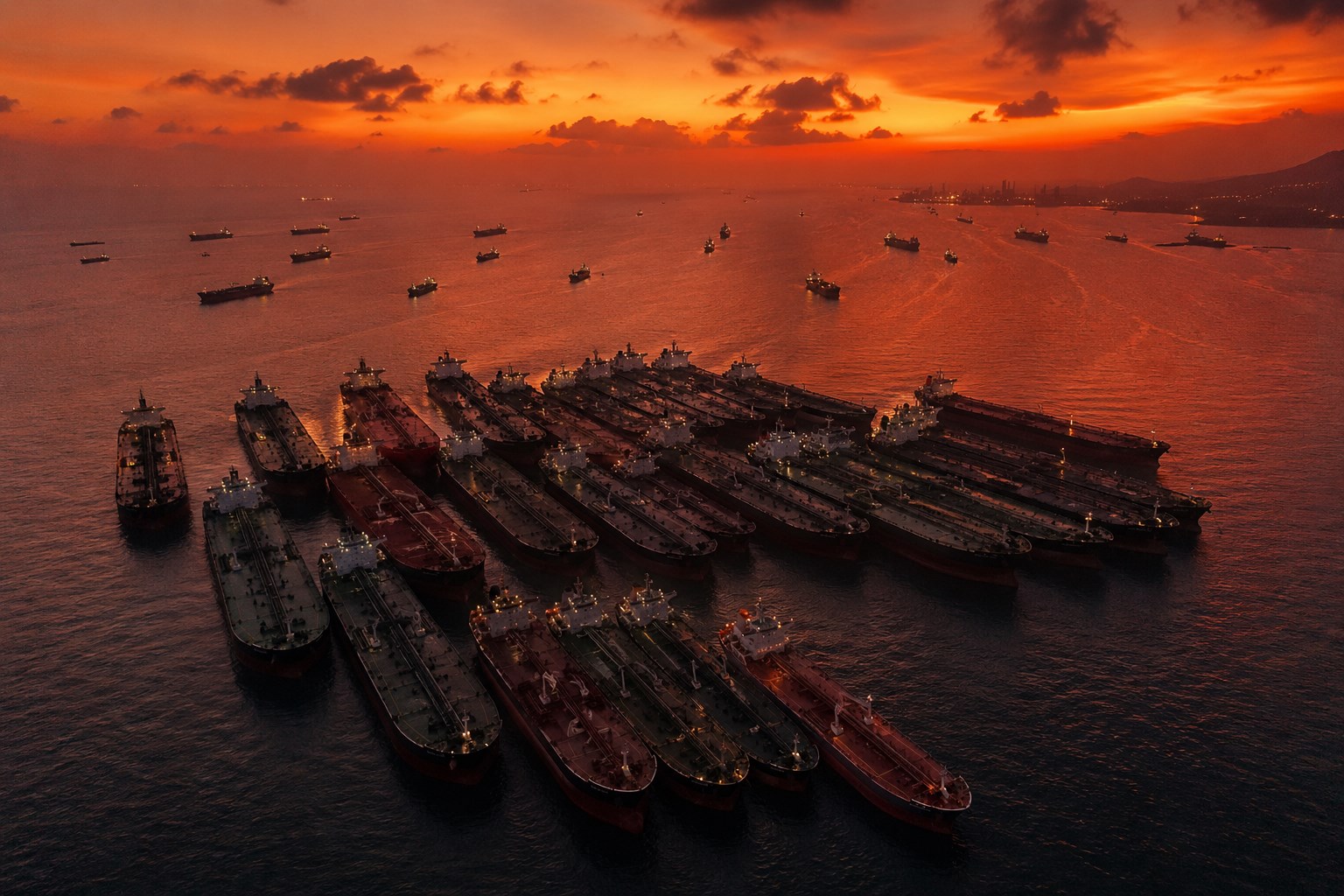
Kharg Island's export terminal has not been struck, has not been seized, and continues to load. Vessel tracking showed the waiting area off Kharg grew to 24 tankers on July 26, up from 21, many running with transponders switched off to evade the blockade. That is a queue, not a closure.
Anyone searching this story will still surface the AI-generated image the president posted on July 26 captioned "STRIKE ON KHARG," along with a mid-July report about the US striking a tanker bound for Kharg rather than the terminal. Neither is a strike on the terminal.
The Premium Is Fully Gone
The cleanest way to see how far this has unwound is against a bank's own arithmetic. JPMorgan puts fair value at $87 a barrel for July and $86 for the third quarter, and noted that even at $100 Brent was only about $13 above fair value, meaning the market was pricing a modest geopolitical premium rather than a large one. At $86.57, Brent is now trading below that fair value estimate. Whatever war premium existed has been fully round-tripped.
No bank has revised anything in either direction since prices fell. Goldman Sachs still carries $80 for the fourth quarter, set on June 16, with an upside case above $120 if Hormuz stays disrupted. Nobody has moved a triple-digit number into a base case, and nobody has cut on the pause either.
Meanwhile the strait itself has not reopened. Roughly 15 ships transited on July 19 against a normal figure near 88 a day, and one maritime risk index has more than 500 vessels anchored or stopped. War-risk insurance still runs 7.5% to 10% of hull value against 0.25% before the war. Bab el-Mandeb traffic recovered to 28 vessels on Tuesday, a four-day high, after falling to 11 following the Saudi refinery attacks.
What It Costs at the Pump
American drivers got their first relief in this cycle, barely. The national average for gasoline slipped to $4.099 a gallon from $4.110, the first daily decline of the run, though still up from $4.019 a week ago and $3.867 a month ago. Diesel kept climbing to $5.321. Pump prices lag crude by about two weeks, so the drop from $100 to $86 has not reached drivers yet. It should, if it holds.
What to Watch
Iran's answer to the Omani plan is the whole game. Accepting joint management would mean abandoning the demand that has kept the strait closed since spring, which is why nobody should assume a quick yes. Rejecting it puts the pause back at the mercy of a president who said Tuesday that infrastructure could be destroyed within hours.
Beyond that: Saudi Arabia's September official selling prices are due in the first days of August, the weekly US inventory report lands Wednesday, and Prime Minister Netanyahu met Trump at the White House on Tuesday with the outcome not expected to be made public. And Kharg still stands, which remains the difference between this price and a far worse one.
This article is for informational purposes only and does not constitute financial or investment advice. Oil market conditions can change rapidly. Consult a qualified financial professional before making investment decisions.