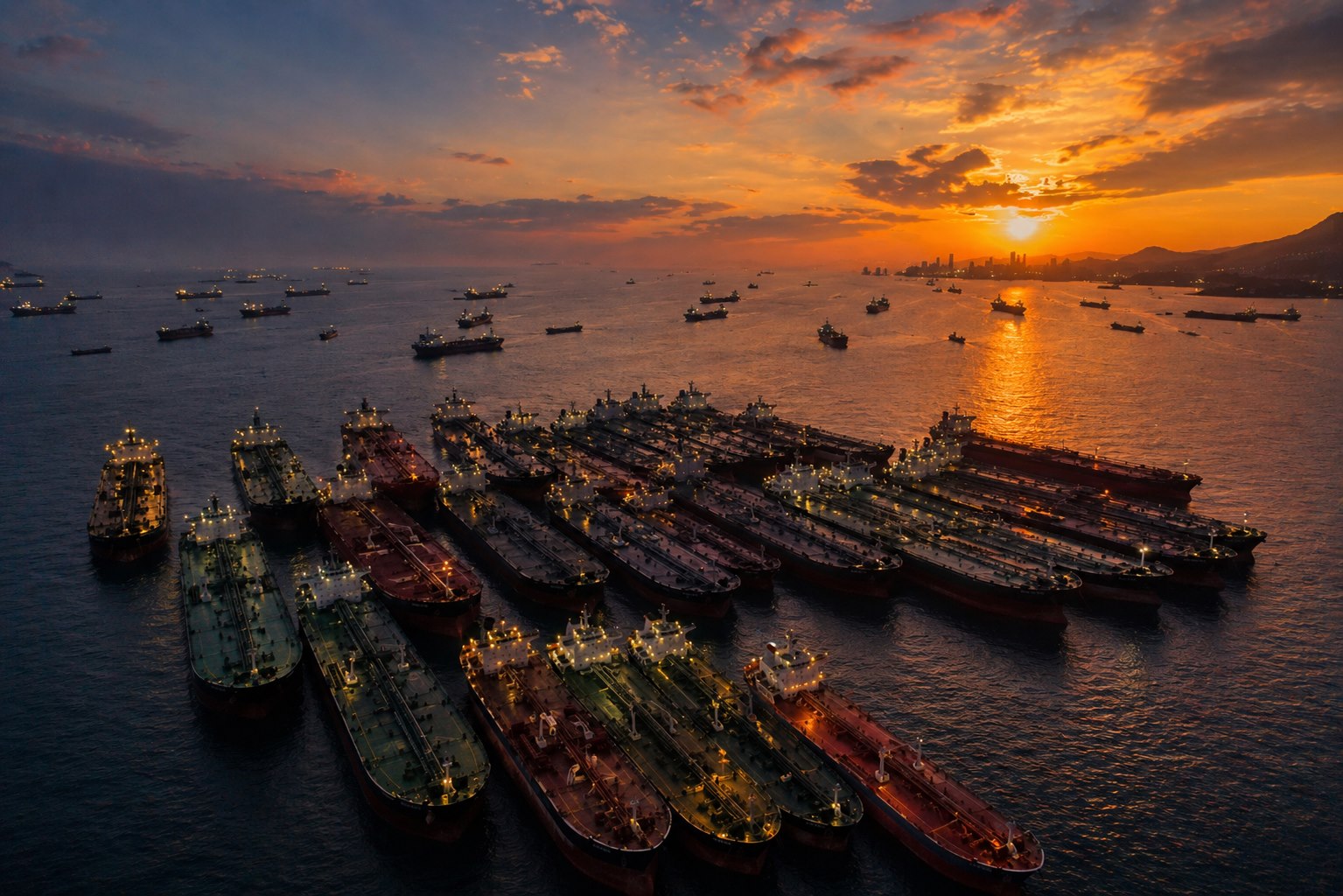
A low transit count tells you how many masters declined to enter the Strait of Hormuz. A U-turn tells you about one who entered and changed his mind. This week produced three of them, and the price noticed.
Brent rose about 3% to $94.38, having traded as high as $94.45 against a previous close of $91.62. WTI gained about 3.4% to $87.28. That is a fifth consecutive session of gains and the highest either benchmark has been since the spring.
Three Supertankers Aborted Mid-Passage
Three China-linked very large crude carriers, all flagged to Hong Kong, reversed course this week rather than complete a Hormuz transit.
The Sea V, laden with Iraqi crude, was heading toward the strait from inside the Persian Gulf on Tuesday when it turned around. It is now idling near the entrance.
The Hestia transited into the gulf along the Omani coast early on Wednesday, then changed direction and sailed back out.
The Erecter, also Iraq-bound, U-turned as well.
A fuel tanker linked to the United Arab Emirates, the Amara, made several U-turns and as of Wednesday was still in the waterway near the Iranian side.
Not everything stopped. Two vessels, the Sweden Prosperity and the Singapore Prosperity, completed transits with their transponders switched off.
One caution on the count. Bloomberg's account of this describes two Chinese supertankers turning back; gCaptain and Rigzone describe three. We have gone with three because two outlets name all three vessels, but the discrepancy is real and we are flagging it rather than picking silently.
Why a U-Turn Is a Different Signal
For three weeks the measurable story here has been how few ships enter the strait. Kpler counted five commodity vessels on Saturday 15 August and none at all on the Sunday. Crossings have run in single digits and low double digits since, against more than 130 a day before the war.
That number describes a decision made in an office, days ahead, by an owner weighing freight against war-risk premiums running 7.5% to 10% of hull value.
A U-turn is a different kind of decision. It is made by a master who already accepted the risk, already committed the vessel, and reversed inside the passage. Something in the immediate picture, a warning, a sighting, a report of the strike that killed a crew member near Khasab on Tuesday, outweighed the cost of arriving late with a full cargo and an unhappy charterer.
Loaded VLCCs do not turn around for tidy reasons. When the ships that already said yes start saying no, the risk has stopped being something the market can price with an insurance quote.
What Is Actually Pushing the Price
Three things are stacked, and only one is about Iran.
The strait itself is the first. The EIA now expects a residual Hormuz-related disruption of about 600,000 barrels a day to persist through the end of 2027, which is a long way from the assumption in its own August outlook that constraints would ease through this month. That month has eleven days left.
The dollar is the second. It weakened after a US Treasury intervention in the long-dated bond market, and a weaker dollar makes dollar-priced crude cheaper for everyone else. Part of today's move is currency rather than oil.
The products market is the third and it is the least discussed. American refinery runs have reached their highest level since September 2019, and distillate stocks have fallen to their lowest in more than a month. Refiners running hard into thin diesel inventories is the setup that turns a crude problem into a fuel-price problem.
A Deal Story Going Round Today Is Two Weeks Old
While checking whether anything had changed diplomatically, searches returned a cluster of reporting that Iran and Oman were close to a Hormuz agreement, that Iran's Supreme National Security Council was about to approve it, and that a US official had said "we expect a deal soon" and that Washington would lift the blockade of Iranian ports once it was announced.
That reporting is from 7 August. It is thirteen days old, it describes a council that has since changed hands, and it was overtaken on 17 August when the 60-day memorandum expired with no successor.
This is the fourth stale item served to us as current in eight days, after a 2023 Aramco story, a February IEA report, and a 1 May blockade-cost figure. It is the second item on our reference page on oil data traps: the date of a number, or a claim, is part of it.
The market settled the question anyway. A credible imminent deal takes the war premium out of crude. Brent went up 3%.
Bessent's Measures Still Have Not Landed
Treasury Secretary Scott Bessent said on 14 August to watch for announcements "next week" of measures unlike anything "in the history of economic isolation on a country." That week ends tomorrow.
What has been published is the Treasury's eighth action of 2026 against Iranian shadow banking, with Bessent saying the system "is buckling under Economic Fury, and the regime is running out of ways to move money." That is a routine round in an existing campaign rather than the unprecedented step described a week ago.
Whether the promised measures arrive, and whether they touch the Chinese banks, insurers and refiners that actually move Iranian barrels, remains the open question. Anything narrower is another list of names attached to a country already under a naval blockade.
What to Watch
Whether more loaded vessels turn back. Three in a week is a pattern rather than an incident, and if it continues the effective closure deepens without anyone announcing anything.
Whether the Sea V and the Amara eventually complete their passages or discharge elsewhere. Where those two cargoes end up is a cleaner read on whether this is a pause or a stoppage than any official statement.
Whether Bessent's week ends with the measures in it. He attached a deadline to himself, which is rare enough in this conflict to be worth marking.
This article is for informational purposes only and does not constitute financial or investment advice. Oil market conditions can change rapidly. Consult a qualified financial professional before making investment decisions.