Oil rose on the last trading day of July on the strength of a claim nobody has been able to check.
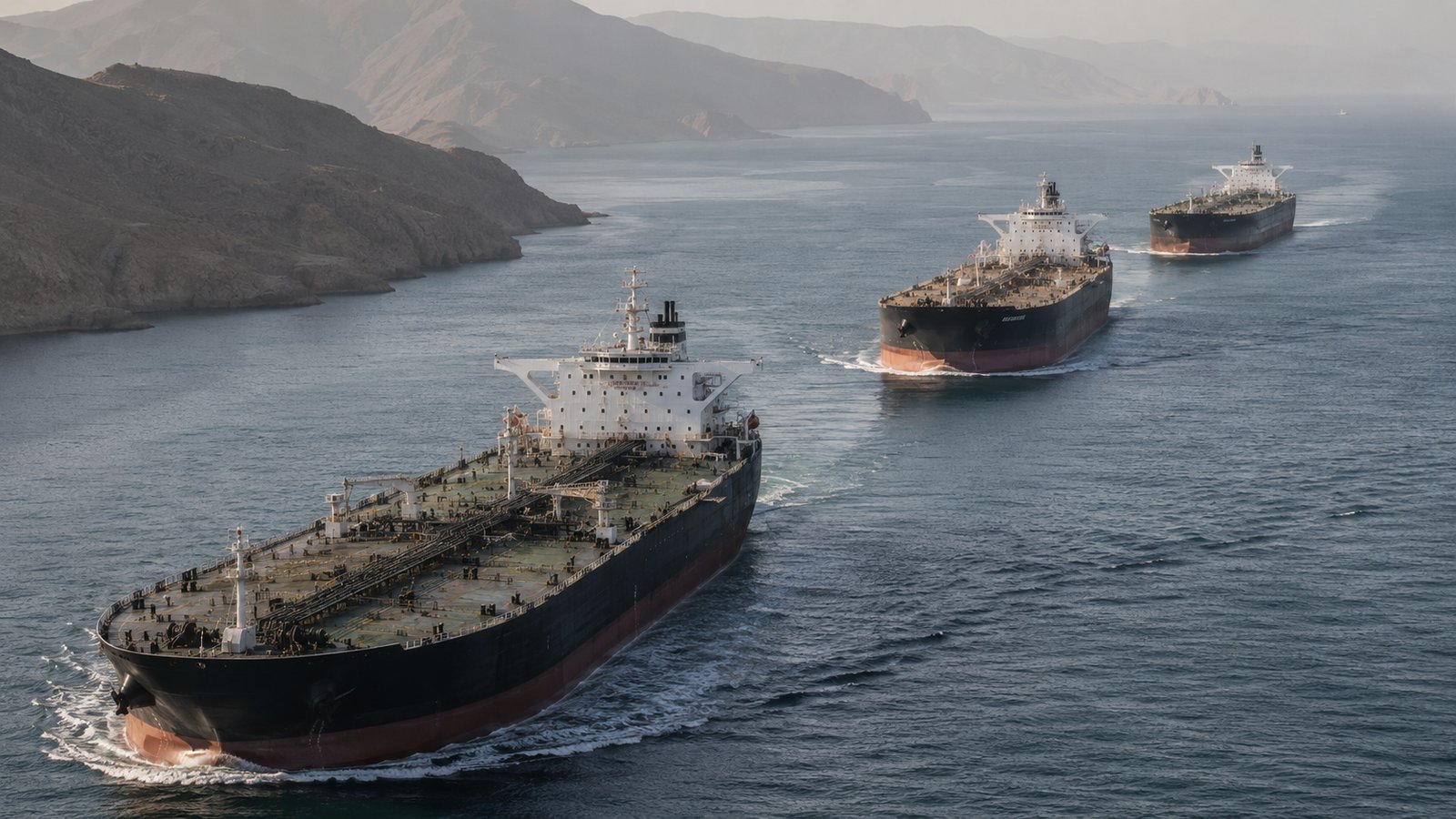
Brent crude traded near $90.20 a barrel late Friday morning, up about 1.4%, with WTI near $85.75, up about 2.6%. Thursday settled at $89.03 for Brent and $83.59 for WTI. The move came after Iran's Revolutionary Guard said it had struck and halted two oil tankers in the Strait of Hormuz.
That claim is the whole rally, and it is worth being precise about how thin it is.
What the Revolutionary Guard Said, and What Is Missing
The IRGC said early Friday that it attacked two tankers transiting a southern route it does not recognise, that the vessels were moving under American military escort, and that four more turned back afterward. The account came through Iranian state media and spread from there.
No vessel has been named. There is no tonnage, no cargo, no damage assessment, and no casualty figure. More telling, neither the UK Maritime Trade Operations desk nor the private maritime security firms that cover this water have issued anything. A genuine attack on a laden tanker in the Strait of Hormuz normally produces a UKMTO advisory and a security assessment within hours. Several hours on, there is neither.
US and British maritime authorities have not confirmed the attacks. Central Command has not responded publicly.
So the market spent Friday morning buying an unverified statement from one side of a war. That may yet be vindicated. It is not confirmed now, and readers moving real money should hold it loosely.
There is a thread of independent support, though weaker than it first appears. Tracking data reported Friday showed only two vessels crossing Hormuz and four turning back. The figure of four also appears inside the Iranian claim, so the two accounts may be the same assertion circulating twice rather than two findings agreeing.
The Heavy Wave Was a One-Off, Not a Restarted Campaign
Washington did not strike Iran again on Thursday night. There was no follow-up to Wednesday's two-hour wave against Iran's coastal radar, anti-ship missiles and naval command, and no Central Command announcement of further operations.
The shape of this campaign now runs: thirteen consecutive nights through July 24, a pause, a single heavy wave ending at 02:00 GMT on July 30, and then nothing. That is punctuated, not sustained.
A caution for anyone searching this story. Video and official releases headlined "eighth consecutive night of strikes against Iran" are circulating high in search results and are dated July 19. They describe the mid-July run, not this week.
Iran Is Widening the Map Instead of Raising the Volume
Iran's answer has gone sideways rather than up.
Iran's army, distinct from the Revolutionary Guard, claimed drone strikes Friday on Ahmad Al-Jaber air base in Kuwait, saying it hit hangars, satellite communications and equipment warehouses, framed as retaliation for the Qeshm Island strike that killed a couple and their two-year-old child. A separate claim named Ali Al Salem air base. Kuwait says it intercepted multiple hostile drones aimed at military facilities early Friday, which corroborates an attempt but not damage or destruction.
Some coverage adds Bahrain to Friday's list. Every specific Bahraini strike we could trace dates to July 21 or earlier, so we are not reporting one.
An Iranian researcher speaking to Al Jazeera described the strategy as horizontal escalation, widening the geography rather than intensifying the fight. Kuwait, Jordan and the Egyptian Mediterranean in one week fits that description better than any account centred on Tehran.
Why Brent Is About to Look $2 Cheaper on Monday
A technical note, because it will otherwise read as a crash.
The September Brent contract expires today. From Monday the quoted front month becomes October, and October is trading roughly $1.70 to $2.20 below September because the curve is backwardated, meaning nearer barrels cost more than later ones. Thursday illustrates it exactly: September settled at $89.03 and October at $86.88, a $2.15 gap for the same commodity on the same day.
Nothing will have happened to the oil. Headlines that compare Monday's October price against Friday's September price will manufacture a two-dollar drop out of a calendar change. The same trap is live in natural gas, where the August contract expired Wednesday and at least one major finance portal is still displaying it, eighteen cents above the real front month.
For the record, every Brent figure in this article is the September contract, consistent with our coverage all week.
The Month Was Excellent and the Week Was Not
Both things are true and most coverage is picking one.
July closed up about 22% for Brent and 20% for WTI, the first monthly gain since April and the largest since March. Measured from last Friday, though, Brent is down about 6.9% and WTI about 4.1%, because the run to $100.69 on July 23 collapsed into the $84.09 low on July 28 before Wednesday's 7.91% rebound.
That is a market with no settled view, oscillating on each day's shipping data. One analyst summary put it well: traders have stopped trading the war and started trading the transit counts.
The Bearish Case Nobody Is Leading With
Running underneath Friday's rally is a genuinely bearish set of facts, and Reuters gave it equal weight.
Commonwealth Bank of Australia estimates Hormuz traffic has recovered to 30% to 35% of pre-war levels, and notes that a rebound to 50% or 60% could reassert oversupply. Twenty-five ships transited Bab el-Mandeb on Thursday. Qatar moved an LNG cargo out through Hormuz. Two very large crude carriers, roughly two million barrels each, made the passage.
Against that: only two vessels crossed Hormuz on Friday, and QatarEnergy has extended its force majeure to customers through October while buying 33 replacement cargoes. A company does not book three months of substitute supply if it expects the strait to function.
China's July manufacturing figures also came in contracting more than expected, which is a demand argument nobody in the Gulf controls.
Saudi Arabia Built a Coalition for the Other Waterway
Riyadh convened military chiefs from 43 countries and announced a multinational maritime defence alliance for the Red Sea, Bab el-Mandeb and the Gulf of Aden.
Two details do the work. First, only 14 of the 43 signed the joint declaration: Saudi Arabia, Kuwait, Bahrain, Qatar, Pakistan, Turkey, Egypt, Jordan, Yemen, Bangladesh, Nigeria, Sudan, Djibouti and Somalia. Second, and more striking, this coalition covers the Red Sea rather than Hormuz. It answers the Houthi blockade of Saudi ports declared on July 20, not Iran's grip on the strait that carries a fifth of the world's oil.
The chokepoint doing the most damage is the one the alliance does not address.
The Insurance Repricing Has Not Happened Yet
Our reporting on war-risk premiums stands, with a timing point that matters.
The working figure remains 7.5% to 10% of hull value for a Hormuz transit, quoted by Marcus Baker of Marsh on July 22, against roughly 0.25% before the conflict. Nothing newer has been published, so anyone citing a current rate is citing July 22.
The Lloyd's and IUA Joint War Committee circular of July 29 that added Saudi Arabia to the listed areas triggers the customary 72-hour notice period under London market war risks policies. That means it bites around August 1, which is to say now. The repricing of Saudi-linked voyages is imminent rather than done. The same circular also removed Pakistan from the listed areas and adjusted the northern boundary of the Gulf of Aden zone.
Damietta: Egypt Confirmed the Drone, and Iran Denies It
An update to our Thursday report, including on our own framing.
Egypt's cabinet stated that preliminary investigations found a drone caused the fire that hit the American-owned floating regasification unit Energos Winter and the LNG carrier GasLog Salem. Crews evacuated safely and the fire was controlled.
Nobody has claimed the attack. The Houthis called reports of their involvement unfounded. Iran has denied involvement, which cuts against the New York Times account we cited on Thursday, which rested on two anonymous Iranian sources saying the operation was meant as a demonstration. That was single-sourced when we ran it and we said so; Tehran's denial now sits on the other side of it. No new attack has followed in the Mediterranean.
Abqaiq: Here Is Exactly How the False Number Is Being Made
The claim that Aramco halted Abqaiq and took roughly 7 million barrels a day offline is still circulating, and the mechanism behind it is now clear enough to name.
Seven million barrels a day is Abqaiq's nameplate processing capacity. Aggregators have taken the fact that the facility was targeted and converted its total capacity into an outage volume. Those are entirely different claims, and the conversion happens without anyone reporting an actual production loss.
No wire service has confirmed a shutdown, Aramco has made no statement, and no force majeure has been declared. What is better supported is that drones struck the Abqaiq area and the East-West pumping station on July 27 and that satellite imagery shows burn scars near degassing vessels. Damage is not a halt.
Attribution is contested three ways, with Saudi Arabia blaming Iran-backed groups operating from Iraq and the Islamic Resistance in Iraq denying it and pointing to Yemen.
Jizan, by contrast, is solid: the 400,000 barrel a day refinery has been down since July 27 after the July 25 Houthi strike, with damage to the gasification complex and a tank farm, and repairs running into mid-August.
Kharg Started Loading Again, and a Number Going Around Is Not What It Looks Like
Kharg Island's terminals sat empty for most of the week. Satellite imagery collected on July 29 showed all three export terminals without a berthed vessel, the western one for eleven days and the eastern since July 25.
Then on July 30 a tanker loaded roughly 710,000 barrels of Iranian crude at Kharg's T-Jetty, according to United Against Nuclear Iran. That is an Aframax-sized lift rather than a very large crude carrier, and it is far below the terminal's normal rhythm. But it means loading at Kharg is sharply reduced, not halted, and it resumed after the imagery that showed the berths empty.
On the queue of tankers waiting offshore, a warning about daily numbers.
Counts as low as two and three have appeared this week and are being read as the queue emptying. They come from narrower satellite passes. The tracking firm that published the July 29 figure attached its own caveat that coverage on that pass was narrower than usual, which limited the count. The firm's last full-width collection, on July 26, found 24. United Against Nuclear Iran, counting independently from different imagery, put at least 23 tankers at the Kharg anchorage on July 25, at least 15 of them laden.
The decisive check is simpler than any of that. For the queue to have drained, those tankers had to sail through Hormuz, and on July 27 the strait recorded six transits in total with not one of them a tanker. Nothing left. The honest reading is a queue that has held in a band of roughly 16 to 24 vessels since early July, and daily swings in that series say more about satellite coverage than about ships.
One number to disregard entirely: a figure of at least 52 tankers is circulating attached to Kharg. It is not a Kharg count. It refers to vessels anchored or loitering near the Eastern Outer Port Limits off Johor, Malaysia, roughly 6,000 miles away, and it is published as a separate daily series that has run between 51 and 56 all week.
The Forecasters Finally Moved, Slightly
After a week in which no bank revised anything, Reuters published its monthly poll on Friday and it went up.
The survey of 31 economists and analysts now sees Brent averaging $85.22 in 2026, from $84.50 in June, and WTI at $80.14 from $79.49. Modest, but it reverses the June poll, which had cut forecasts on improving Hormuz shipping. UniCredit's Tobias Keller attributed the support to a geopolitical risk premium likely to persist through the second half.
Individual houses have still not moved. Goldman Sachs holds $80 for the fourth quarter while noting the odds of going higher have increased and the odds of going lower have not. JPMorgan carries $86 for the third quarter and $80 for the fourth. Barclays remains the high base case at a $96 average for 2026.
Diesel Is Still the Real Squeeze
Gasoline has plateaued. The national average for regular sits at $4.106 a gallon, essentially unchanged on the week after climbing about 26 cents in a month.
Diesel has not plateaued. It reached $5.353, up 11.3 cents in a week, and now sits within 46 cents of its all-time high. Global refining activity is the lowest for this time of year since 2020, and US distillate stocks are roughly 11% below the five-year average. Jizan's outage removes another 400,000 barrels a day of refining until mid-August.
Crude gets the headlines. Diesel is what moves freight, farm equipment and construction, and it is the price doing damage.
What to Watch
OPEC+ meets virtually on Sunday to set September levels. The group approved an increase of 188,000 barrels a day for August, and reporting suggests it intends to approve a similar September step and then pause increases for the remainder of 2026. Several outlets have garbled this into a pause on the September increase itself. Nothing is decided until Sunday.
Beyond that: whether any maritime authority ever corroborates Friday's tanker claim, whether the Joint War Committee listing repriced Saudi voyages as the notice period expires, and whether a second LNG carrier follows the Al Areesh out. One ship leaving is an anecdote.
Kharg Island's export terminal has still not been struck, which remains the difference between this price and a far worse one.
This article is for informational purposes only and does not constitute financial or investment advice. Oil market conditions can change rapidly. Consult a qualified financial professional before making investment decisions.