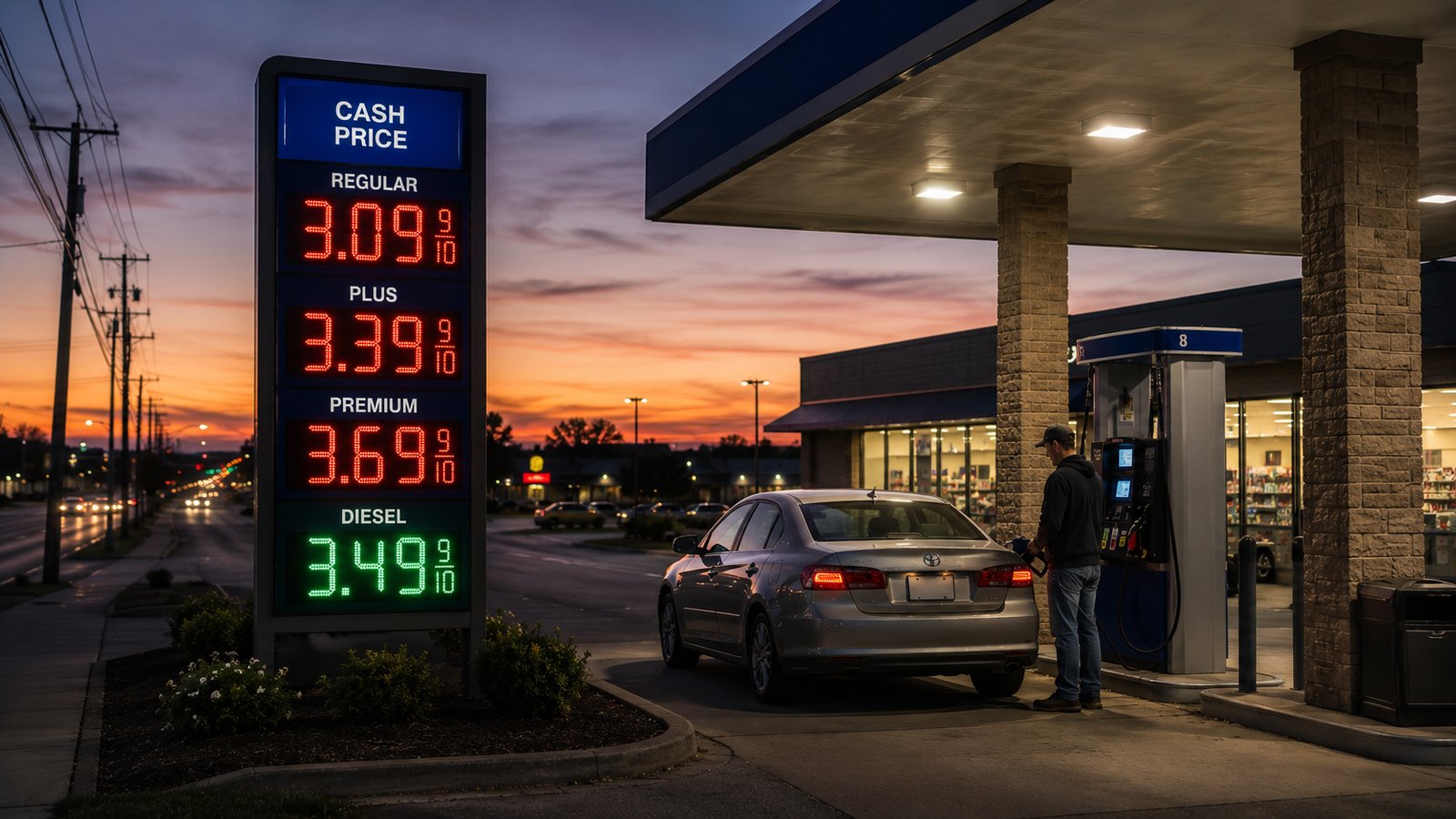
The 72 million Americans that AAA expects on the roads this July 4 weekend are getting a holiday gift the spring said they wouldn't: falling pump prices. The national gasoline average sits at $3.83 a gallon, down nearly 50 cents from the wartime peak of $4.56 in late May. The relief is real and it is still arriving, because the crude collapse that produced it is only weeks old. The asterisk is historical: $3.83 is still the most expensive Fourth of July fill-up since 2022, a reminder of how far prices flew before they fell.
Behind the pump, the oil market headed into the long weekend in an odd and telling posture: sitting on four-month lows, digesting a bad jobs number that somehow helped it, and waiting on an OPEC+ meeting on Sunday that sources say will add even more supply.
The Jobs Shock That Lifted Oil
Thursday's June employment report, released a day early for the holiday, was a miss by half. The US added 57,000 jobs against expectations near 110,000, and April and May were revised down by a combined 74,000. The unemployment rate ticked down to 4.2%, one of the few soft spots of good news in the release.
Oil's reaction ran backward at first glance. Crude dipped about 2% in the morning, with WTI trading into the $67s, then reversed and settled higher, WTI at $68.69 and Brent at $71.80, snapping a three-session losing streak. The mechanism is the Federal Reserve. A weak jobs number pushed the odds of a September rate cut above 75% on futures markets, and the dollar fell to a two-week low. A cheaper dollar makes oil cheaper for the rest of the world, and rate cuts support future demand. For one session, bad news for workers was good news for barrels.
The bigger picture did not change. The week overall was flat, which after three weeks of steep declines counts as stabilization rather than recovery. Brent is still down roughly 24% on the month, US crude stockpiles have drawn for twelve straight weeks yet prices sit at four-month lows anyway, and the force pressing down on the market, the supply wave returning through the Strait of Hormuz, is still building. Saudi exports are back to roughly 90% of their pre-war baseline. The question hanging over the market is no longer whether supply comes back. It is how much more gets added on top.
Sunday's Answer
That is what OPEC+ decides this weekend. The seven countries managing the group's quotas, Saudi Arabia, Russia, Iraq, Kuwait, Kazakhstan, Algeria, and Oman, meet Sunday to set August output, and Reuters reported this week that three OPEC+ sources expect another increase of roughly 188,000 barrels a day, the same size as the last several, which would make five consecutive monthly hikes. No final decision has been made, and with crude in the high $60s a pause would be the market-friendly surprise. But every signal points to the group continuing to unwind its old cuts and defend market share as the strait reopens.
There is a softening nuance: the quota increases remain partly symbolic, because the group's actual production collapsed during the war and is still climbing back toward its paper targets. An August hike changes next month's flows less than it signals intent. The intent, five meetings running, has been more oil.
A Funeral, and a Pause
The diplomacy that ended the war is on hold for the most Iranian of reasons: a state funeral. Ceremonies for Ali Khamenei, the supreme leader assassinated in February on the eve of the strait's closure, began Friday in Tehran and run through July 9, ending with burial in Mashhad. Officials project 15 to 20 million mourners, which would make it the largest funeral in Iran's history. Whether his son and successor, Mojtaba Khamenei, appears in public for it, something he has not done since taking the role in March, is its own quiet drama.
The talks pause from a position of mild progress. A second round of indirect negotiations ran in Doha on Wednesday, with Qatari and Pakistani mediators shuttling between delegations that still will not sit in the same room. Trump said the negotiations were "progressing well," and mediators said the next round will convene "at the earliest possible time" after the funeral. The stand-down that ended last weekend's strikes has now held for nearly a week without incident, and Oman has delivered a proposal on the strait's permanent arrangements. The final deal remains unwritten, and the hard terms, inspections, frozen assets, tolls, remain unresolved inside the 60-day window.
For the holiday weekend, the market's calendar is simple. Sunday brings the OPEC+ decision. Next week brings the funeral's end and, after it, the talks. And at the pump, barring a surprise from either, the relief keeps flowing through in nickels and dimes a week, the slow-motion consumer dividend of a war that ended faster than anyone priced.
This article is for informational purposes only and does not constitute financial or investment advice. Oil market conditions can change rapidly. Consult a qualified financial professional before making investment decisions.