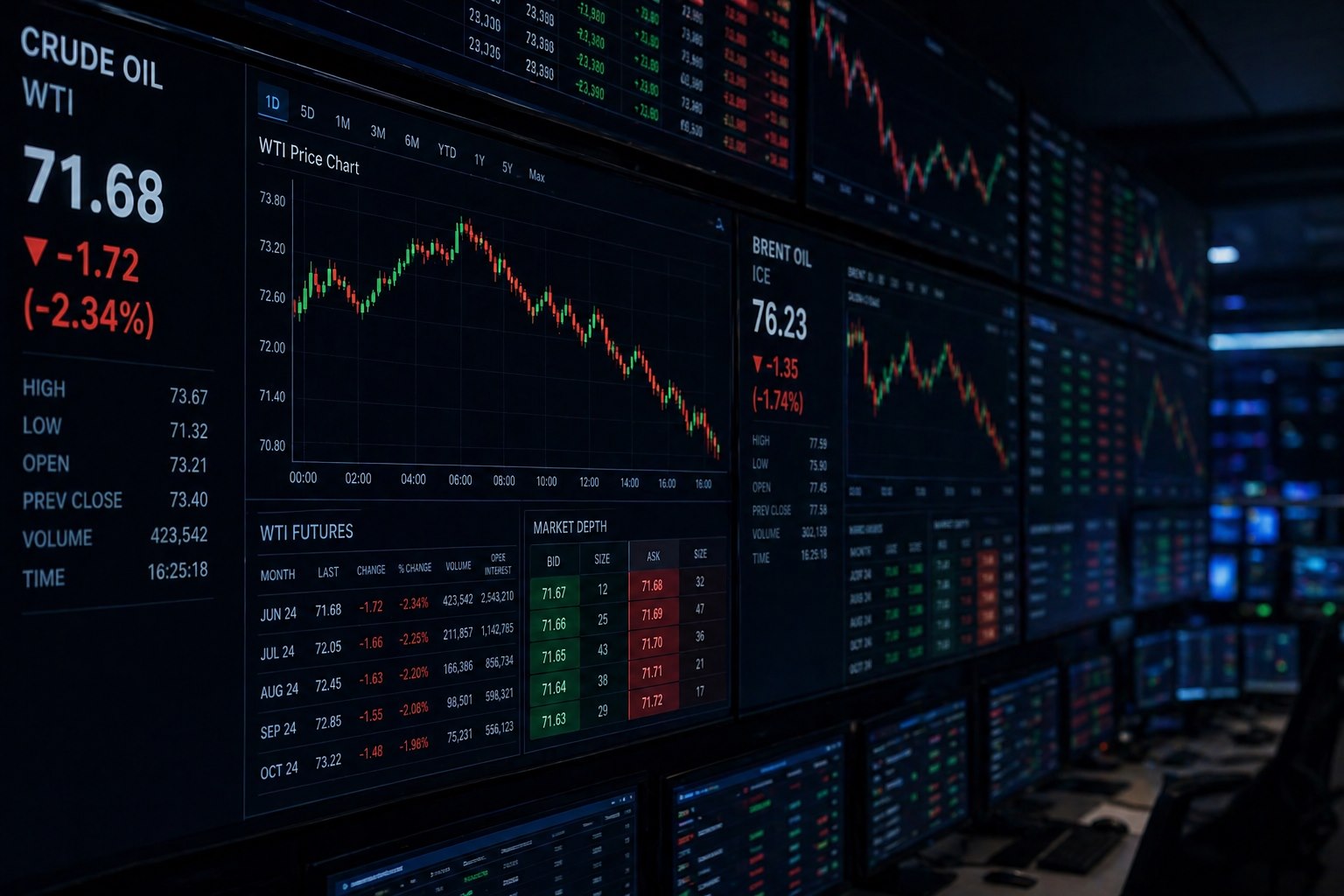
Oil has never sustained $200 per barrel. The highest WTI ever closed was $147.27 in July 2008. Brent peaked at $147.50 the same month. Both crashed within weeks.
Getting to $200 and staying there would require something the 2008 spike did not have: a genuine, sustained reduction in global supply that demand destruction alone cannot offset fast enough. Here are the specific conditions that could produce it.
1. The Strait of Hormuz Closes Completely and Stays Closed
The Strait of Hormuz handles roughly 20% of global oil and liquefied natural gas flows. A full, sustained closure — not the partial, contested disruption seen in 2026, but one where tanker traffic stops entirely for months — would remove 17 to 20 million barrels per day from global seaborne supply.
No combination of strategic reserves, pipeline bypasses, and alternative shipping routes can fully replace that volume in the short term. The IEA's combined emergency reserve commitment covers roughly 1.6 billion barrels across member countries. At 10 million barrels per day of net shortage, that buffer lasts about five months.
If the closure extended beyond that window with no resolution, the market would have no ceiling. $200 would not be the top.
The partial, contested closure seen during the 2026 crisis pushed WTI past $110 at its peak. A genuine full closure, with no bypass routes, would likely push prices above $150 within weeks and toward $200 within two to three months if sustained.
2. Major Saudi Infrastructure Is Permanently Damaged
Saudi Arabia holds the world's largest spare production capacity — roughly 2 to 3 million barrels per day above its normal output level. That spare capacity functions as the global oil market's circuit breaker: when supply disruptions happen elsewhere, Saudi Arabia turns the tap up.
Removing that capacity permanently would restructure the global supply curve. The attacks in April 2026 damaged Manifa and Khurais, cutting a combined 600,000 bpd. That is significant but recoverable. A more severe scenario — strikes on Abqaiq, which processes roughly 7% of global crude supply — would be in a different category entirely. The 2019 Abqaiq attack temporarily knocked out 5.7 million bpd and sent prices up nearly 15% in a single day.
Permanent, unrepairable damage to Abqaiq plus continued Hormuz disruption would almost certainly push prices past $150. Sustained above that level, $200 becomes possible within six to twelve months.
3. A Second Major Supply Shock Hits Simultaneously
The oil market can absorb one large shock. It is much less equipped to handle two at once.
Scenarios where a second shock compounds an existing one:
- Russian export disruption from NATO-Russia escalation or new sanctions enforcement while Hormuz remains closed
- Libya, Nigeria, or Iraq political collapse adding another 1 to 2 million bpd of outages on top of Gulf disruption
- A major hurricane season simultaneously knocking out Gulf of Mexico production during a Middle East crisis
Each of these alone would not get oil to $200. Combined with an ongoing Hormuz disruption and damaged Saudi infrastructure, any one of them could.
4. Strategic Petroleum Reserves Are Exhausted
The IEA coordinates emergency reserve releases among its 31 member countries. The US Strategic Petroleum Reserve holds roughly 350 million barrels. Total IEA emergency stocks accessible for release are around 1.5 to 1.6 billion barrels.
These reserves have been a ceiling on prices in every major supply crisis since 1974. But they are a finite ceiling. If a supply shock is large enough and sustained long enough, reserves eventually run low, and the market loses its price anchor.
The US SPR was already drawn down to multi-decade lows after the 2021 to 2022 releases. At current levels, a major coordinated release could cover perhaps 150 to 180 days of a moderate supply gap. A larger gap depletes that cushion faster.
A world where SPR stocks fall below 200 million barrels while a major supply disruption remains unresolved is a world where $200 oil becomes a realistic outcome, not a tail risk.
5. Demand Fails to Fall Fast Enough
High prices eventually destroy demand. That is what stopped the 2008 spike and what constrains every oil price runup. But demand destruction takes time, and the speed matters.
At $100 per barrel, consumers feel pain but adjust slowly — drive less, postpone purchases, shift to alternatives over months. At $150, the adjustment accelerates. But in the short run — the first four to eight weeks of a severe price shock — demand is relatively inelastic. People still need to get to work, heat their homes, and move freight.
The window between a supply shock and meaningful demand response is exactly where prices can overshoot to extreme levels. If supply is removed faster than demand adjusts, the price has to rise until demand is forcibly rationed. At extreme enough supply removal rates, that rationing price can be very high.
How Far Away Is $200?
At the April 2026 peak, the partial Hormuz disruption and Saudi infrastructure damage pushed WTI past $110. That was the closest the market came, and it was still less than half the distance worth worrying about. Once a US-Iran framework was signed in June and the strait began reopening, WTI fell back below $75 and the war premium drained out entirely. The market moved sharply away from the $200 conditions, not toward them.
Getting to $200 from a calm, premium-free market would require a sequence:
- A breakdown of the 2026 settlement and a re-closure of the strait, this time more complete than the contested closure the market already survived
- Additional, unrepairable infrastructure damage in Saudi Arabia beyond the recoverable hits of 2026
- SPR and coordinated IEA releases failing to contain the price move
- A second supply shock from another region landing at the same time
None of those are base cases. But the 2026 crisis was a reminder that supply disruptions which look like tail risks can arrive quickly, and that a chokepoint carrying a fifth of the world's oil does not need to close completely to move prices by $40.
$200 oil is not a forecast. It is a description of conditions. With the 2026 crisis resolved, those conditions are further away than they were at the April peak. The mechanics that would produce them have not changed, which is why the scenario is worth understanding even when the market is quiet.
This article is for informational purposes only and does not constitute financial or investment advice. Oil market conditions can change rapidly. Consult a qualified financial professional before making investment decisions.