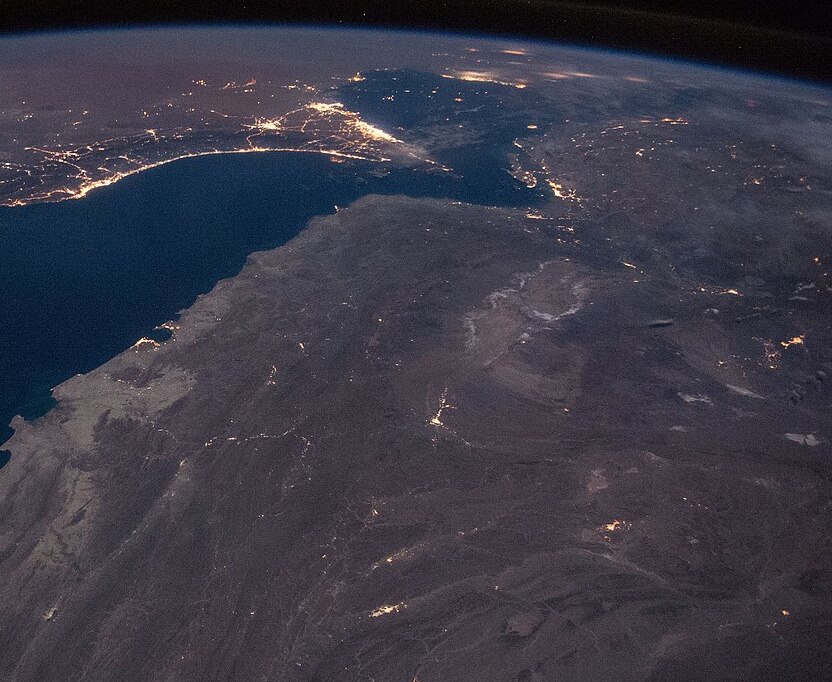
The Strait of Hormuz is 21 miles wide at its narrowest point. Through that gap moves roughly 20 million barrels of oil per day — about one in every five barrels consumed anywhere on Earth. No pipeline, no road, no alternative sea route can fully replace it.
That geography is why a conflict involving the strait sends oil markets into crisis within days.
What It Is and Where It Sits
The strait is a narrow waterway connecting the Persian Gulf to the Gulf of Oman and, from there, to the Arabian Sea. Iran sits on the northern shore. Oman sits on the southern shore. At its tightest point, between the Iranian coast and Omani-administered territory, the navigable channel is 21 miles across.
Within that channel, tankers use two designated shipping lanes: one inbound, one outbound, each two miles wide, separated by a two-mile buffer zone. Large tankers pass within sight of each other.
What Flows Through It
Before the 2026 crisis, the strait carried roughly 20 to 21 million barrels per day of crude oil, condensate, liquefied natural gas, and refined petroleum products. That figure represented:
- About 20 percent of global oil consumption
- About 30 percent of all seaborne oil trade
- Roughly 25 percent of global LNG trade
The major exporters transiting Hormuz include Saudi Arabia, Iraq, the UAE, Kuwait, Iran, and Qatar. Qatar's LNG exports, which supply large shares of Europe and Asia, move almost entirely through the strait. There is no other way out for them.
Why Closure Causes Disproportionate Damage
The core problem is the absence of bypass capacity that can absorb the full volume.
Two significant pipeline alternatives exist. Saudi Arabia operates the Petroline, also called the East-West Pipeline, which carries crude from its Eastern Province to the Red Sea port of Yanbu at a capacity of roughly 5 million barrels per day. The UAE operates the Habshan-Fujairah pipeline, moving about 1.5 million barrels per day to the Gulf of Oman port of Fujairah, bypassing Hormuz entirely.
Combined, these routes can handle 6 to 7 million barrels per day at their theoretical maximum. Before the 2026 conflict, more than 20 million barrels per day moved through the strait. The bypass infrastructure covers less than a third of normal Hormuz throughput even at full capacity.
LNG has no meaningful bypass at all. Qatar's export terminals are inside the Gulf. There are no LNG pipelines to alternative ports. If Hormuz is effectively closed, Qatari LNG does not move.
The Historical Record
The strait has been threatened before, and once partially disrupted.
During the Iran-Iraq War of the 1980s, both sides attacked tankers in what became known as the Tanker War. The US Navy reflagged Kuwaiti tankers under the American flag and provided armed escorts. Iran mined parts of the Gulf. The USS Samuel B. Roberts struck one of those mines in 1988. The US then destroyed several Iranian oil platforms in retaliation, in an engagement called Operation Praying Mantis. The strait never fully closed, but insurance rates spiked and some shippers rerouted when possible.
Iran threatened closure again during the 2012 nuclear sanctions standoff. US officials said any attempt would be met with military force. The strait stayed open.
In both cases, the threat was the mechanism. The strait itself kept moving oil.
What the 2026 Closure Did
The 2026 conflict was the first time the strait was effectively closed to normal commercial traffic in its recorded history.
Before the conflict, Hormuz throughput exceeded 20 million barrels per day. By April 2026, the IEA put effective throughput at roughly 3.8 million barrels per day, almost entirely through the bypass pipelines and limited permitted traffic. That was a reduction of more than 16 million barrels per day, the largest single supply disruption since the 1973 oil embargo by cumulative barrel count.
Brent crude, trading near $67 the prior year, crossed $112 in late April 2026. US retail gasoline prices rose roughly 27 percent at the peak of the disruption. When a US-Iran framework was signed in June 2026 and the strait began reopening, Brent fell back below $80 and the premium unwound nearly as fast as it had built.
Why This One Required a Peace Settlement
In previous Hormuz crises, the threat was the leverage. The strait stayed open. Reducing the threat was enough to defuse the situation.
In 2026, the strait was constrained by an active US naval blockade, not an Iranian threat alone. Reopening it required a negotiated end to an active conflict. Both parties had to agree, and both had to act. Diplomatic channels through Pakistan collapsed in late April, and Iran's foreign minister flew to Moscow instead before talks eventually resumed. The disruption lasted nearly four months, far longer than any previous Hormuz episode, precisely because the mechanism for resolution was not a phone call. It was a peace settlement, and it took months of mediation to reach one.
That is the structural lesson of 2026. A chokepoint closed by a shooting war does not reopen when tensions ease. It reopens when the war ends.
This article is for informational purposes only and does not constitute financial or investment advice. Geopolitical and market conditions can change rapidly.
Cover photo: The Strait of Hormuz as seen from the International Space Station, 2011. NASA/ISS, public domain.