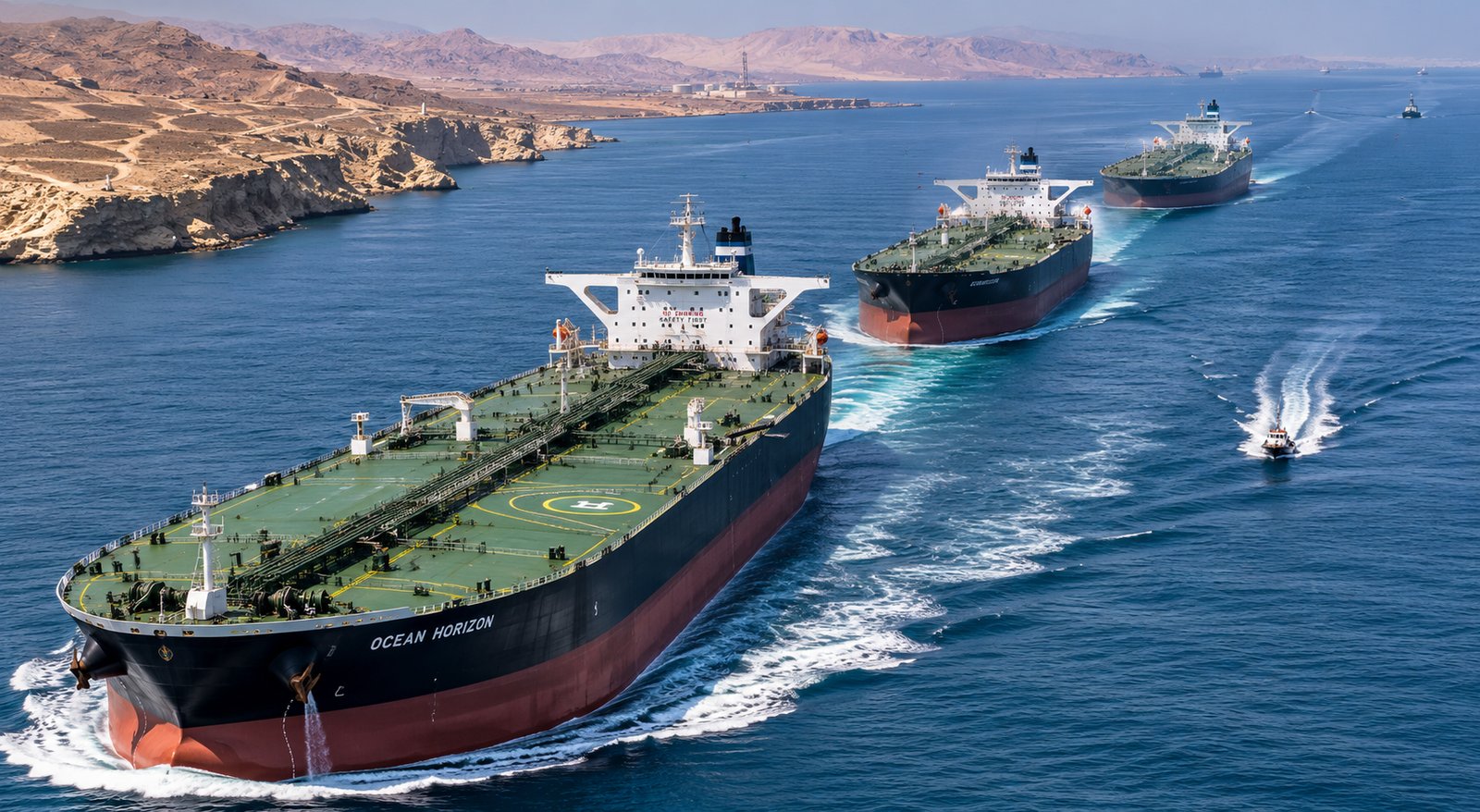
Two days after Trump signed the Iran framework at Versailles, the most important confirmation came not from a podium but from a ship's transponder. Three Saudi supertankers, carrying roughly 6 million barrels of crude, crossed the Strait of Hormuz. Vice President JD Vance said about 12 million barrels moved through the strait overnight, the highest single-night volume since the crisis began in February, and that Iran had held its fire on commercial shipping for a second consecutive night. After four months in which the blockade was the entire story, the barrels are finally moving.
The market response was telling. Oil did not fall further. WTI held around $77 and Brent near $80, both roughly flat on the day after Wednesday's break to multi-month lows. Crude is still heading for a weekly loss of about 8% and sits down roughly 38% from its April war peak. But the floor that arrived this week held, and it held for a specific reason: the diplomacy underneath the deal had its first stumble.
The First Talks Slipped Before They Started
The framework Trump signed is not the final agreement. It opens a 60-day window to negotiate the hard questions, and the first session of that negotiation was supposed to begin today in Switzerland, at Bürgenstock, with US, Iranian, Qatari, and Pakistani delegations. It was postponed. The Swiss foreign ministry confirmed the delay. Vance attributed it to logistics, which are "never simple or predictable."
The fuller reason traces back to Lebanon. Iranian reporting indicates Tehran held its delegation back over Israel's continued operations in southern Lebanon, the same front Foreign Minister Araghchi named this week as a core condition for moving the framework forward. The nuclear track and the Lebanese front are now visibly tied together. A delay in one is a signal about the other.
That postponement is what kept oil from extending its slide. A market that had priced near-certain reopening got a small reminder that the path from signed framework to final deal runs through 60 days of contested negotiation, and that the negotiation can be held hostage to events on a battlefield Israel controls and Iran does not.
A Lebanon Ceasefire, Hours Later
The Lebanese fuse that this column has flagged repeatedly was, at least for now, partly capped. A new Israel-Hezbollah ceasefire took effect at 4 p.m. Lebanon time on Friday, brokered by the United States and Qatar. It came after an overnight escalation that killed four Israeli soldiers and at least 16 Lebanese civilians. Israeli forces remain in the southern buffer zone and have warned they will respond to any Hezbollah attack.
Whether it holds is the open question. A previous ceasefire on this same front collapsed two weeks ago. But a truce taking effect on the very day the nuclear talks slipped over Lebanon is the kind of sequencing that can put those talks back on the calendar quickly. The next few days on the Israel-Lebanon line now matter as much to the oil price as anything happening in the strait.
Khamenei Speaks, Grudgingly
The silence at the top of the Iranian state, which held through the signing, broke on Thursday. Supreme Leader Mojtaba Khamenei publicly authorized the deal and the direct talks with Washington, but framed it as a concession he made against his own judgment. "I, as a matter of principle, held a different view," he said. "However, I granted my permission." He added that future face-to-face negotiations "will not mean accepting the enemy's opinion," and warned that if the American side "wants to be greedy, they will not accept it."
This resolves one uncertainty and creates another. The approval the deal needed is now explicit rather than inferred from Trump's characterizations. But it is a grudging, conditional approval that leaves Iran's negotiators wide latitude to walk away from the 60-day talks if the terms harden. It is permission to negotiate, not endorsement of an outcome.
The Toll-Free Pledge Has an Expiration Date
The published text of the framework settled one of the disputes this column has tracked, and not in the direction Trump described. He has repeatedly said the strait reopens permanently free of Iranian tolls. The text says something narrower: Iran will make its best efforts for safe passage of commercial vessels "with no charge for 60 days only." After that window, the fee question is open. Iran's own negotiator said the strait "will not return to pre-war conditions" and that Iran would "receive a fee for services."
Vance drew a hard line on it. If Iran proposes tolls in the final deal, he said, "there's not going to be a final deal." So the single most concrete economic term in the framework is also one of its clearest fault lines, deferred 60 days and already contested by both sides. On uranium, the text confirmed Iran's position: enriched material stays inside Iran and is down-blended on site under IAEA supervision, not removed. The sanctions language is vaguer still, referencing an "agreed-upon schedule" with no specific commitment on the roughly $24 to $25 billion in frozen Iranian assets.
The Supply Wave Is Real, the Timing Is Not Fixed
For the oil price, the physical reopening is the dominant fact and the dominant risk. Transit through the strait has climbed from a May trough near 9.6 million barrels a day back toward 12 million. Saudi, and reportedly Iranian, vessels are crossing the old blockade line. CENTCOM has waved more than a dozen ships through.
But the mines that closed the strait have not been cleared. French, German, and British de-mining assets are mobilizing, not yet working. Insurers are still pricing war-risk premiums into every hull that transits. Analysts across the IEA, CNBC, and shipping desks agree that full normal throughput is months away, not weeks. The IEA cut its 2026 demand forecast by 700,000 barrels a day this week, reinforcing the bearish case, while OPEC's secretary general dismissed the agency's glut warning outright, asking "what does the IEA see that OPEC and the rest don't see?"
That disagreement is the market in miniature. The war premium is gone. What replaces it is a slower argument about how fast the withheld barrels return and how soft demand is underneath them. Today the barrels started moving and the price held its floor. The next move belongs to whether the strait keeps clearing and whether the talks that slipped today get back on the calendar.
This article is for informational purposes only and does not constitute financial or investment advice. Oil market conditions can change rapidly. Consult a qualified financial professional before making investment decisions.