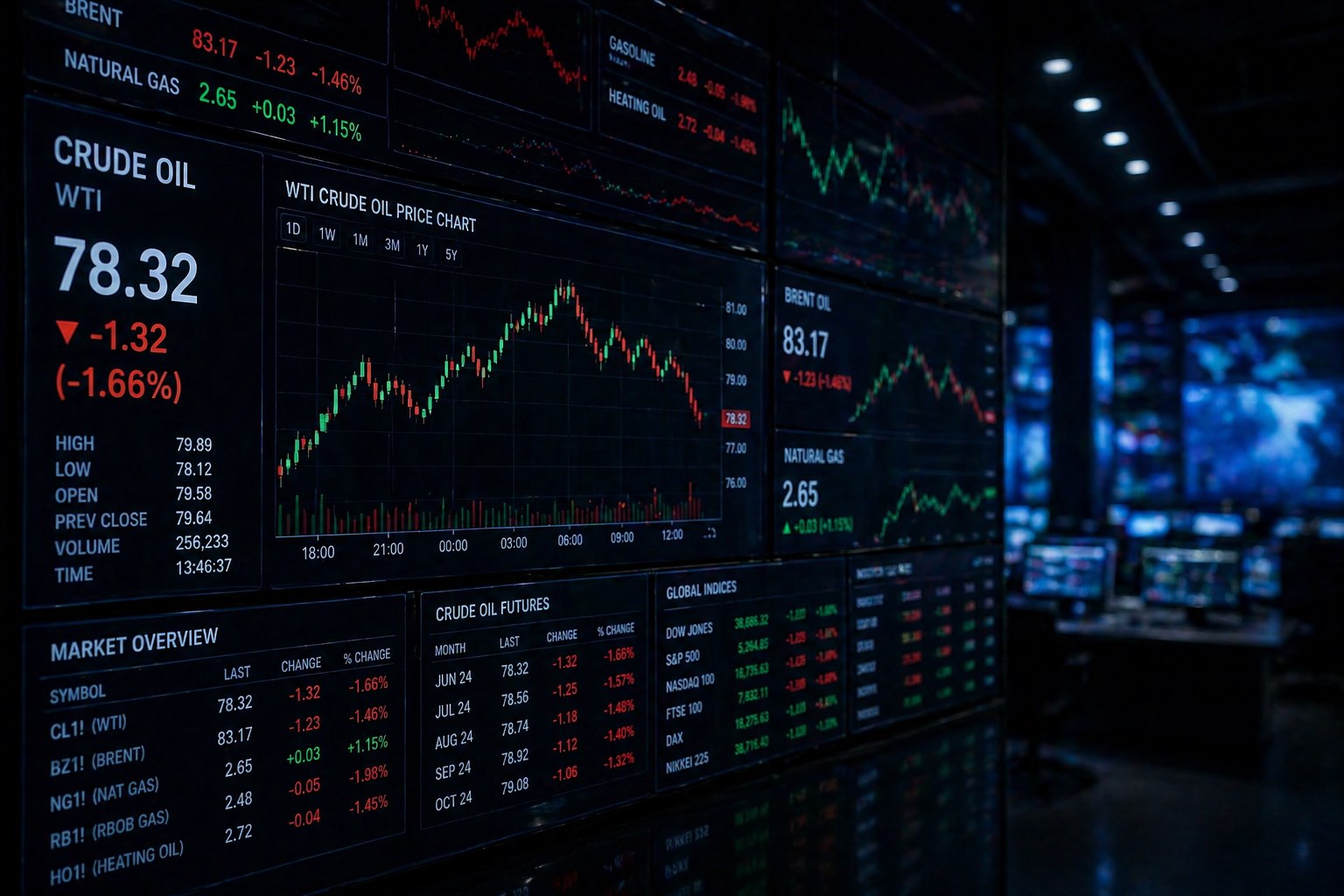
The second quarter of 2026 ended on Tuesday with oil down about 24%, its worst quarterly performance since the pandemic crash of 2020. That number alone undersells what happened. Inside this single three-month window, the world's most important oil chokepoint was blockaded, crude spiked above $110, a US-Iran war was fought and a peace framework signed, and the entire risk premium that drove the spike unwound. The quarter opened in crisis and closed in a glut. Brent settled near $74 and WTI near $71, both roughly back to where they traded the day before the Strait of Hormuz first closed.
For a market that spent April terrified of losing a fifth of global seaborne oil, ending the quarter worried about oversupply is a remarkable turn. It is also a textbook one. A war premium is the fastest-building and fastest-collapsing component of an oil price, and the 2026 episode ran that full arc on a compressed clock.
A War in 90 Days
The timeline is worth laying out, because rarely does an entire oil shock begin and end within one quarter. The strait was effectively closed to normal commercial traffic in late February. By April, with Hormuz throughput cut by more than 16 million barrels a day and Saudi infrastructure damaged, Brent crossed $112, its highest since 2022. US retail gasoline rose more than a quarter. The market priced a prolonged, possibly catastrophic disruption.
Then the direction reversed. A US-Iran framework was signed in mid-June, the strait began reopening under American naval escort, and Gulf producers raced to push withheld barrels back to market. The premium did not fade gradually. It collapsed, exactly as the mechanics predict. Brent gave back $40 in weeks, faster than it had built, and by the end of June the price sat below where the crisis started even though the strait was still not fully open. The barrels that had been feared lost were never actually lost in the quantities the price implied. The fear was priced, and then unpriced.
Why It Kept Falling
What replaced the war premium is a supply story that is structurally bearish. Saudi Aramco restarted loadings at Ras Tanura, and the UAE, Kuwait, and Qatar are all pushing exports back toward normal. The withheld crude is hitting a market where demand looks soft. The clearest sign of the mood came on Tuesday, when Morgan Stanley cut its Brent forecast again, to $75 for both the third and fourth quarters, down from $90 and $80, and flagged a potential surplus approaching 5 million barrels a day in 2027. That is the second forecast cut from a major bank in two weeks, and the direction is uniformly lower.
The supply story has been strong enough to override almost everything thrown at it. Over the final weekend of the quarter, the US and Iran traded direct military strikes, a second tanker was droned, and Iran fired missiles at Bahrain and Kuwait. Oil rose about a dollar and gave most of it back. When live combat in the Gulf cannot rebuild a premium, the market is telling you what it believes: the barrels are coming, and the geopolitics are noise around that trend. China offered a small counterweight, with June factory activity expanding for a third straight month, but a marginally better demand signal does not change the supply math.
What Is Not Finished
The quarter closed with the crisis resolved on price but not on the ground. The strait is reopening, but it is not normal. The mines that closed it have not been cleared, and the multinational effort to do so, now coordinating out of a British command, is estimated at 40 to 50 days before insurers and shippers fully trust the route. Traffic is recovering but remains a fraction of pre-crisis levels, and Iran has still not formally rescinded the closure declaration it issued on June 20.
The deal is signed but unfinished too. The technical talks meant to turn the interim framework into a final agreement are stumbling. US envoys Steve Witkoff and Jared Kushner landed in Doha on Tuesday, but Qatar's foreign ministry made clear they were meeting mediators, not Iran. Tehran sent its own delegation and declined to confirm any direct contact with US officials "at any level," leaving the negotiation in the same indirect, shuttle form it has taken from the start. IAEA inspectors are still not in Iran, and the verification fight that sits at the center of the deal is unresolved.
The next scheduled event is OPEC+ on July 5, which sets August output. The base case is another increase of roughly 188,000 barrels a day, though with Hormuz still impaired the quota decision is as much a forward signal as a near-term change in flows. Whatever the group decides, it points the same direction the whole quarter has: toward more oil. The crisis that defined April is over as a price event. The surplus it gave way to is the story of the second half of the year.
This article is for informational purposes only and does not constitute financial or investment advice. Oil market conditions can change rapidly. Consult a qualified financial professional before making investment decisions.