The war premium stopped climbing back and broke higher. Brent crude jumped above $86 a barrel on Tuesday and WTI topped $80 for the first time in a month, each up about 4% on the day and more than 10% since Friday. Two things drove the move: Iran carried out the first deadly tanker strike of this phase of the conflict, and President Trump moved to take control of the Strait of Hormuz and charge the world to use it.
This is a sharper level than the market has paid all month. Even so, it is not the blowout that a true supply shock would bring, because the one strike that would deliver that shock, a hit on Iran's Kharg Island export terminal, still has not come.
The First Fatal Tanker Strike
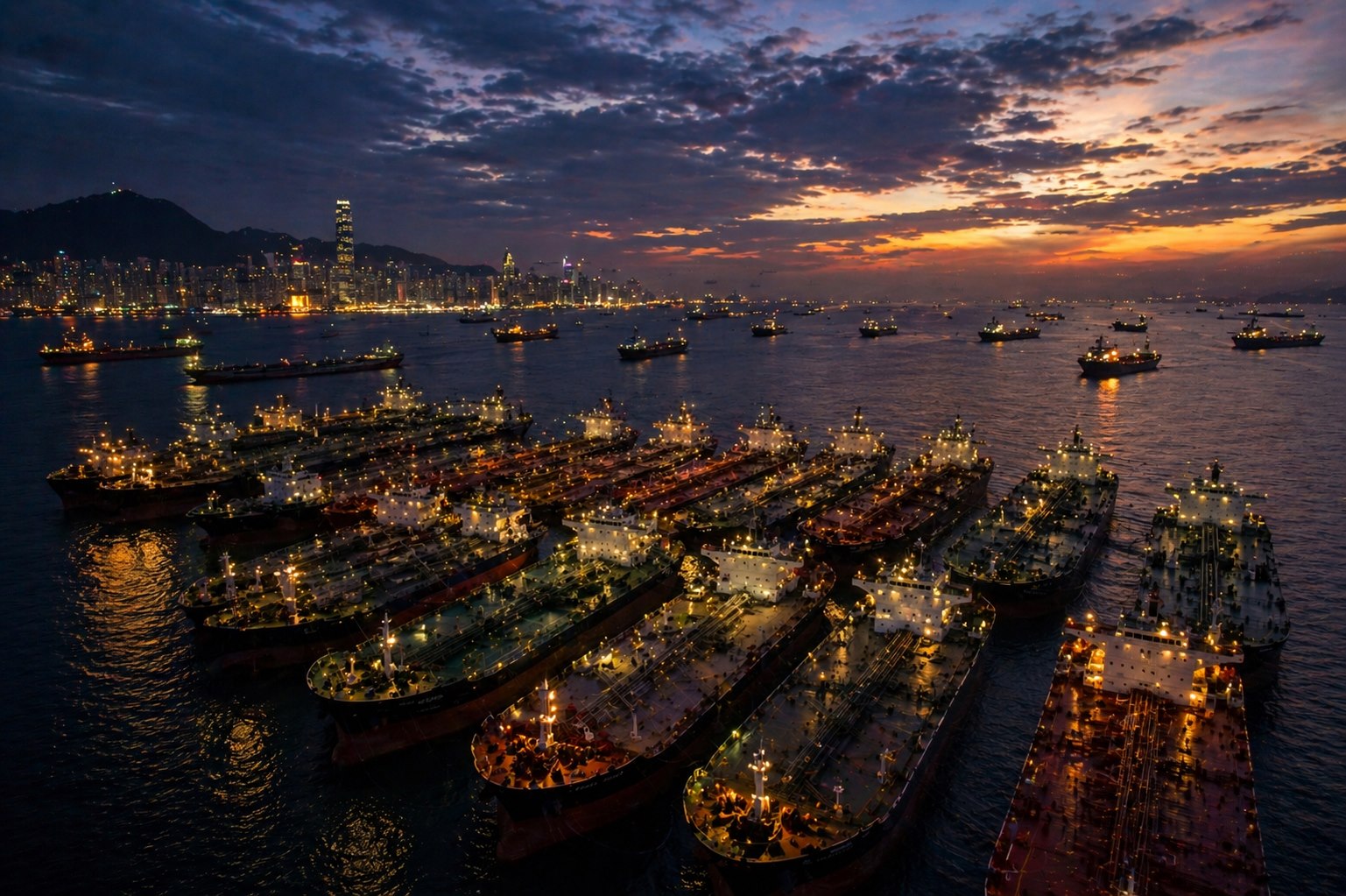
Overnight, Iranian cruise missiles struck two tankers linked to the UAE's state oil company ADNOC as they moved through the southern lane of Hormuz, inside Omani waters. The company identified the vessels as the VLCCs Al Bahyah and Mombasa B, both large crude carriers. One Indian crew member was killed and eight were injured, four seriously, and both ships were significantly damaged, according to ADNOC and the UAE defense ministry.
The Revolutionary Guard claimed responsibility, saying the tankers had ignored warnings and tried to pass through a mined route. That justification is Iran's account and is not independently verified. What is confirmed, and what matters to the market, is that for the first time in this phase the target was crude tankers rather than a container ship, and that a strike in the strait has now killed a mariner. The threat to shipping is no longer theoretical.
Trump Moves to Toll the Strait
The second driver was a policy shift with no recent precedent. Trump declared that the United States would act as the guardian of Hormuz, reinstated a naval blockade on Iranian vessels transiting the strait, effective Tuesday afternoon, and said all other cargo passing through would be subject to a 20% charge on its value, to reimburse the US for securing the waterway. He named Saudi Arabia, the UAE, Qatar, Bahrain, and Kuwait as the beneficiaries who should pay.
Bloomberg calculated that a 20% levy would imply roughly $30 million on a full supertanker of crude. Whether it can actually be collected is an open question, but the market did not wait to find out. A toll on the world's most important oil chokepoint is a direct new cost on every barrel that moves through it, and it lands on top of already elevated war-risk insurance. Trump has, in effect, taken a page from Iran's own playbook, turning control of the strait into leverage and revenue.
The Strike That Still Hasn't Come
For all of that, the market's true worst case remains unrealized. The US bombed Iran for a third consecutive night, hitting military and naval targets at Bushehr, Chah Bahar, Jask, Konarak, Abu Musa, and Bandar Abbas, sites tied to Iran's ability to attack ships. None of them was Kharg Island, the terminal that handles roughly 90% of Iran's crude exports, and no Iranian oil-export infrastructure has been destroyed.
That is why $86 is not $110. A blockade, a toll, and tanker attacks all raise the cost and danger of moving oil through Hormuz. A strike on Kharg would remove Iranian barrels at the source. The market is pricing a more dangerous route, not the loss of the oil itself, and the gap between those two scenarios is roughly the gap between today's price and the war peak.
The Glut Still Caps It
The other reason the premium has a ceiling is unchanged. The physical market is oversupplied. The Energy Information Administration still models Brent averaging near $70 in the fourth quarter on a large expected build, OPEC+ is adding barrels for a fifth straight month, and Saudi Aramco cut its selling price to Asia by the most in decades. That structural surplus is why forecasters keep a downside case alive even now.
The analyst community has swung its risk to the upside. Goldman Sachs says that if Hormuz does not normalize by the end of July, Brent likely ends 2026 above $100, with an adverse path reaching $125. JPMorgan sees around $86 this quarter easing to $80. TD Securities calls a move to $100 "quite possible" if physical shortage risks prove real. The through-line: the tail is now a live scenario, not a remote one.
What to Watch
Transit through Hormuz has collapsed to a fraction of normal, with only 57 crossings over the Friday-to-Sunday window against a peacetime norm near 130 a day. The US kept some 8.5 million barrels moving on Monday with military escort. Diplomacy is stalled: Qatar and Pakistan are pushing to revive talks and Iran's foreign minister has been shuttling through Oman, but three straight nights of strikes have left the June framework in pieces, with no ceasefire and no new round confirmed.
The next move depends on the same short list. If Kharg is hit, Goldman's $100-plus scenario goes live within a day. If the blockade and toll actually choke transit further, the squeeze does the work a strike has not. And if the mediators pull off a ceasefire, the glut is waiting to pull prices back toward the $70s. For now, oil has broken higher, but the barrels are still flowing, and that is the only reason it has not broken further.
This article is for informational purposes only and does not constitute financial or investment advice. Oil market conditions can change rapidly. Consult a qualified financial professional before making investment decisions.