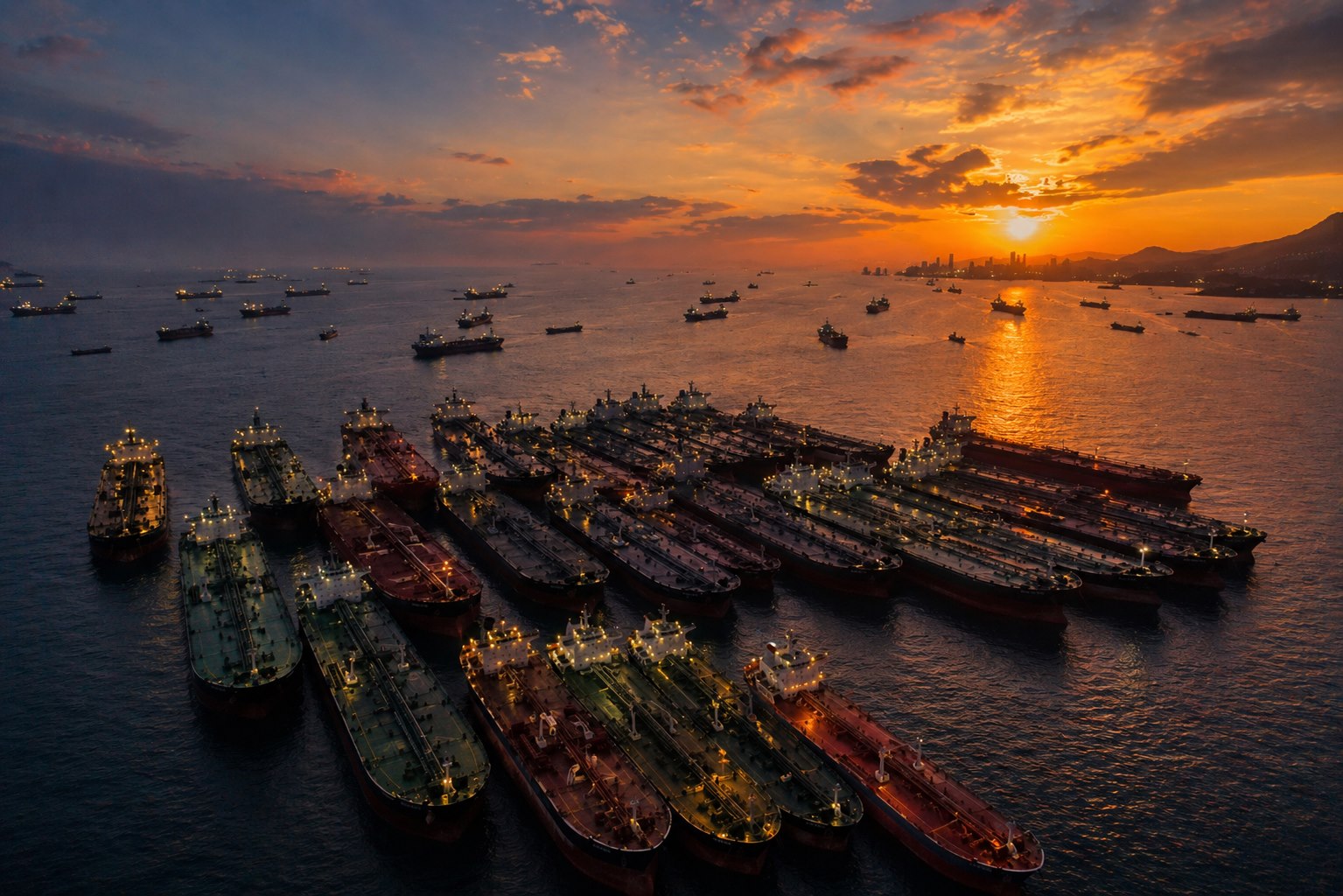
Oil pushed to a fresh six-week high on Wednesday. Brent crude touched about $95 a barrel intraday before easing to settle near $93.88, up 3.1% on the day, and WTI reached $88.60 before closing around $86.50, up 2.6%. It was the third straight up session, and it came on a day when the official inventory data said prices should have fallen.
That contradiction is the story. The Energy Information Administration reported a crude build, the kind of number that caps a rally, and the market ignored it completely and rallied anyway. The war is now setting the price, and the supply cushion that capped every spike earlier this year is no longer doing the job.
The Market Shrugged Off a Build
The EIA said commercial crude stocks rose 2.0 million barrels in the week to July 17, to 411.7 million, against expectations for a draw. Gasoline built 0.8 million barrels and distillate 1.4 million, refineries ran at 96.1%, and total commercial petroleum inventories rose 11.6 million barrels on the week. On any ordinary day, a broad build like that pulls prices lower.
This was not an ordinary day. Prices rose about 3% into the teeth of that report, which is the clearest sign yet that the market has stopped trading the barrels in tank and started trading the barrels that might not move at all. For most of this month this site has argued that the surplus underneath would catch every rally. A build day that closes up 3% is that argument losing in real time.
Trump's New Doctrine: A Bridge for a Ship
The escalation that drove the move was a threat with no recent precedent. On Wednesday, President Trump said on social media that for every Iranian attack on a ship in the Strait of Hormuz, by missile, rocket, drone, or any other device, the United States would bomb and destroy one bridge or one power plant. He said the targets could include infrastructure next to or inside Tehran. The statement was reported across CNBC, the Washington Post, Axios, and CNN.
This is a shift in kind. Through eleven nights, US strikes have hit military targets tied to Iran's ability to attack shipping. A doctrine that trades civilian infrastructure, bridges and power plants, for attacks on ships is a deliberate widening of the target set, and the market read it as a signal that the campaign is going to get bigger rather than wind down. Iran responded by threatening to strike US-linked infrastructure and energy facilities across the region if the threat is carried out. That is an Iranian claim about future action, not a confirmed event.
The Ceasefire Is All but Dead
The diplomatic track went the other way. Secretary of State Rubio said Iran is not serious about reaching a deal, noting that Tehran made commitments in June's memorandum and violated them within two weeks. Trump dismissed near-term negotiations. The 10-day ceasefire proposal from regional mediators is still technically on the table, but neither side has accepted it, and the direction of travel on Wednesday was plainly away from a deal. The sticking point has not changed: the United States and its Gulf partners reject Iranian control over the strait, which is what Iran is trying to secure.
Eleven Nights, and Still Not Kharg
Central Command confirmed an 11th consecutive night of strikes on Iran, hitting military operations centers, maritime capabilities, aircraft hangars, and drone storage. No 12th night was confirmed by Wednesday afternoon. As on every night before it, none of the strikes hit Kharg Island's oil export terminal, which handles roughly 90% of Iran's crude exports. Vessel trackers reported Kharg loading without interruption, with multiple tankers alongside on satellite imagery. The terminal that would turn this war into a true supply shock is still standing and still loading. A US claim that Iran has attacked more than 30 commercial vessels through Hormuz over three months is a Central Command figure and is not independently verified, as are the various battlefield and casualty claims from both sides.
Three Supply Fronts at Once
What makes this different from the single-chokepoint scares earlier in the year is that the market now has three separate supply threats to price.
The first is Hormuz, where the strikes and tanker attacks continue. The second is the Red Sea. Yemen's Houthis have not yet attacked a Saudi-linked vessel under the blockade they declared on July 20, but the Joint Maritime Information Center reported Wednesday that they have deployed missiles and drones near Bab el-Mandeb and completed preparations to strike shipping. The posture escalated even though the kinetic threshold has not been crossed, and tankers are already rerouting: a Chinese supertanker turned back rather than transit. The third front has nothing to do with Iran. Loadings at the Caspian Pipeline Consortium terminal near Novorossiysk are suspended again after Ukrainian drones struck moored tankers there, putting roughly 1.58 million barrels a day of mostly Kazakh crude at risk.
Three fronts, and a US Strategic Petroleum Reserve sitting at a 43-year low near 316 million barrels after months of crisis draws, which leaves Washington with a thinner buffer than it has had in decades.
Where It Goes
The analysts have not caught up to the tape in a single day, but the framing has shifted. ING told clients on Wednesday that supply risks are mounting as ceasefire hopes fade, outweighing the bearish inventory picture. Goldman Sachs still carries a base case near $80 Brent for the fourth quarter, with a scenario above $120 if Hormuz stays severely disrupted through the third quarter. The gap between those numbers is the same one it has been all month. The difference now is that the market is walking toward the top of it.
The triggers are unchanged and the odds keep shifting the same way. A ceasefire still resets everything lower, but Washington just called Iran unserious and threatened to widen the war. A strike on Kharg still sends Brent toward $120 within a day, and it has not come. And the second and third chokepoints, once hypothetical, are now staffed with weapons and closed pipelines. Oil at a six-week high, on a day the inventory data said sell, is the market pricing all of it at once.
This article is for informational purposes only and does not constitute financial or investment advice. Oil market conditions can change rapidly. Consult a qualified financial professional before making investment decisions.