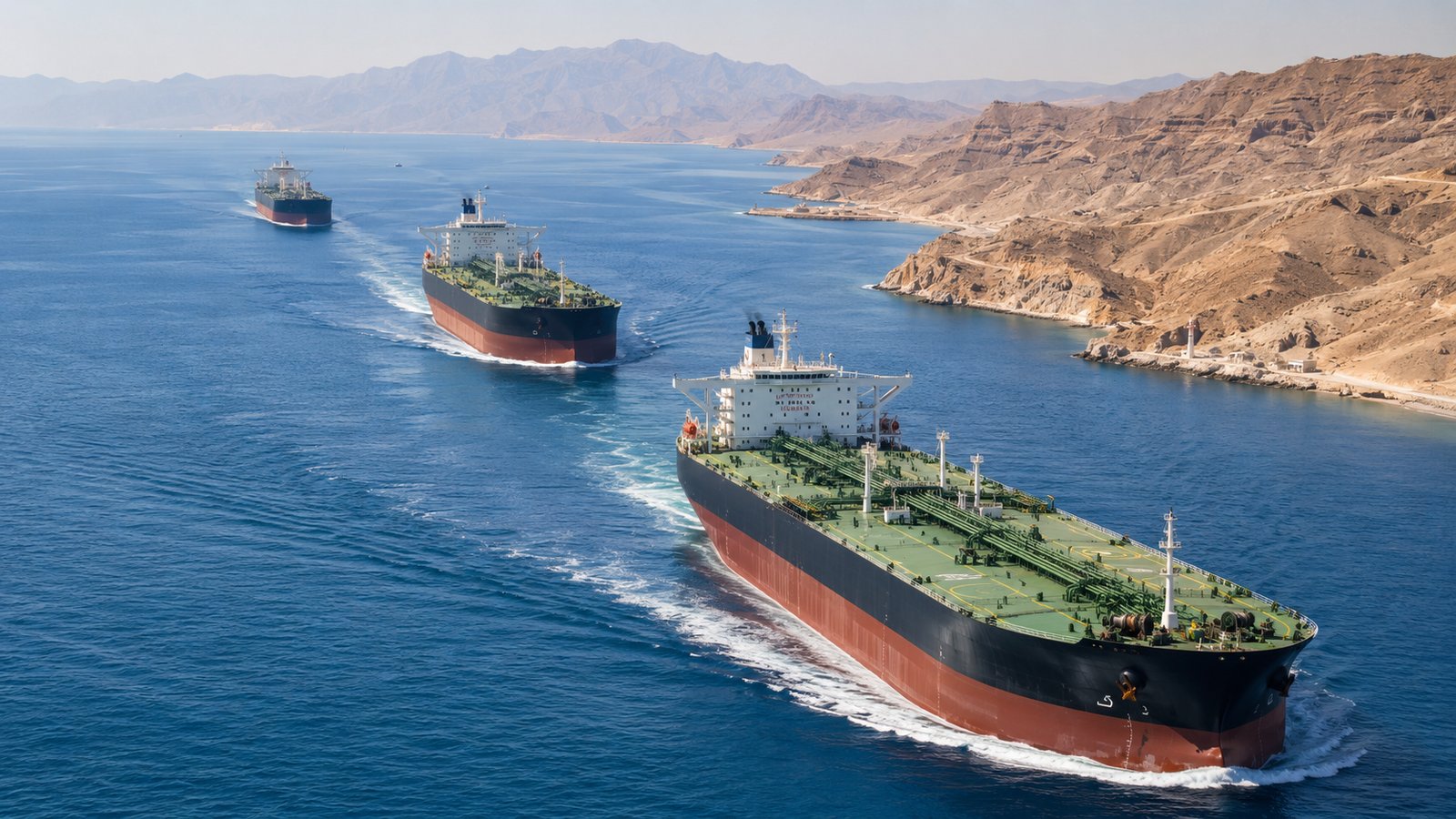
Oil ran hard again on Thursday. Brent crude traded near $98.44 a barrel in the European morning, up about 4.6% on the day, and WTI pushed past $90 to around $90.14, up 3.8%. Both are up roughly $4.50 from Wednesday's settle, and Brent is now on course for a monthly gain near 35%, one of the largest in a decade. The six-week high we reported yesterday did not hold. It broke higher.
The reason is a threshold this site has been watching for a week. The Houthi blockade of Saudi Arabia stopped being a declaration and became an attack.
The Second Chokepoint Went Live
For days the Houthi blockade was a posture: missiles and drones moved into position near Bab el-Mandeb, warnings emailed to shipowners, tankers turning back to avoid the strait. No vessel had actually been hit. Overnight that changed. The Saudi-owned tanker Encelia was struck in the Red Sea roughly 70 nautical miles southwest of Al Shuqaiq, catching fire at the bow. Its crew is safe and there was no oil spill, according to Saudi Arabia's Transport General Authority and the UK Maritime Trade Operations agency, which described the vessel as hit by an unknown projectile.
That is the first confirmed attack under the blockade the Houthis declared on July 20, and it is why the price jumped. Until Thursday, the market was pricing the risk that the second chokepoint might close. Now it is pricing a second chokepoint that is actively being contested, on top of a Strait of Hormuz that is already barely functioning. Bab el-Mandeb carries a large share of Saudi crude bound for Europe, and at least seven vessels have already rerouted to avoid it.
The Houthis claimed more than the confirmed facts support. They said they hit two tankers, the Encelia and a second vessel named Layla, with large fires on both, and forced roughly ten ships to retreat. Only the Encelia strike is independently verified. Treat the second tanker and the ship count as Houthi claims until a neutral source confirms them. The confirmed event is serious enough on its own: for the first time, a Saudi oil tanker has been hit in the Red Sea.
Twelve Nights, and the Threat Not Yet Carried Out
The military campaign kept its rhythm. Central Command confirmed a 12th consecutive night of US strikes on Iran, hitting maritime capabilities, missile and drone storage, coastal surveillance, and air defenses. What did not happen is as notable as what did. On Wednesday, President Trump threatened to bomb one bridge or power plant for every Iranian attack on a ship in Hormuz. As of Thursday morning, no bridge or power plant has been reported hit, and no specific Iranian ship attack has been tied to triggering it. The threat stands; it has not been executed. Iranian state-linked media threatened retaliation against regional infrastructure with American interests, which is a claim about future action, not an event. Reports that Jordan intercepted Iranian missiles on Wednesday are unverified in their detail.
The Ceasefire Did Not Move
Diplomacy stayed stuck. Iran is still pushing the 10-day truce proposal; the United States still wants a longer pause and freedom-of-navigation guarantees through Hormuz before agreeing to anything, and Secretary of State Rubio's assessment that Iran is not serious about a deal carried into Thursday's coverage. There was no acceptance, no rejection, and no counter that changes the picture. The proposal is alive on paper and going nowhere in practice, which is roughly where it has sat all week.
Still Not Kharg, and Still the Whole Difference
The one development that would dwarf everything above has still not come. There is no confirmed strike on or seizure of Kharg Island's oil export terminal, which handles roughly 90% of Iran's crude, and no report contradicts that it is still loading. That remains the line between the current price and a far higher one. Everything happening now, the Encelia strike, the 12th night, the blockade, raises the cost and danger of moving oil. None of it has removed Iran's own barrels at the source. A market at $98 without a Kharg strike shows how much room is still above it if that line is ever crossed.
The third front is unchanged and still off the radar. Loadings at the Caspian Pipeline Consortium terminal near Novorossiysk remain suspended after repeated Ukrainian drone strikes on tankers, with the terminal's tanks reported full, keeping roughly 1.58 million barrels a day of mostly Kazakh crude off the market. It has nothing to do with Iran, and it is not coming back yet.
Where This Leaves It
A week ago the bullish case rested on threats: a blockade that might bite, a terminal that might be hit, a ceasefire that might collapse. This morning one of those threats became real. The Houthi blockade is now a shooting blockade, the second chokepoint is contested rather than merely warned about, and Brent has repriced toward $98 to reflect it.
What has not changed is the shape of the risk. A ceasefire still resets everything lower, and it is no closer. A strike on Kharg still sends oil sharply higher, and it has not happened. The gap between those two outcomes is the whole trade, and every day this week the market has taken another step toward the higher one, not because the worst case arrived, but because the merely bad cases keep turning real one by one.
This article is for informational purposes only and does not constitute financial or investment advice. Oil market conditions can change rapidly. Consult a qualified financial professional before making investment decisions.