Brent crude has moved more than 20% in the past three weeks. If you booked an oil change in that window, you paid the same price you would have paid before it.
That is not a pricing failure. It is what the cost structure of an oil change actually looks like, and it is worth understanding, because the same logic explains why your fuel bill responds to crude in days while other oil-derived products take months or never visibly respond at all.
What an Oil Change Costs
Consumer price guides for 2026 cluster in fairly consistent ranges. A conventional oil change is commonly quoted at roughly $35 to $75. A synthetic blend runs around $50 to $100. Full synthetic is usually quoted at $65 to $125, and dealership service is typically near the top of that range or above it.
Treat those as indicative rather than precise. They come from consumer guides and quick-lube marketing rather than from a price-reporting agency, there is no equivalent of a settlement price for a service performed in ten thousand independent shops, and the number varies with your vehicle, your city and how much oil your engine holds.
That absence of an authoritative price is itself the first useful point. Crude oil has a published settlement price every trading day. An oil change does not have a price at all in the same sense. It has a menu.
The Crude Content of a Litre of Motor Oil
Start with what is actually in the bottle.
Motor oil is base oil plus an additive package. The additives, typically 15% to 25% of the finished product, are detergents, dispersants, anti-wear compounds, viscosity modifiers and antioxidants. They are specialty chemicals with their own supply chains and their own pricing, and they are not crude.
The base oil is where crude enters, and even there the link is weaker than it looks. Conventional base oils are refined from the heavier end of the barrel, so they do track crude, loosely and with a lag. But higher-grade base oils are a different story. Group III base oils are severely hydrocracked and priced more like a specialty product than a fuel. Polyalphaolefins, the classic full-synthetic base, are built from chemical feedstocks. And a significant share of premium synthetic base oil is now gas-to-liquid, made from natural gas rather than crude at all.
So when you buy full synthetic, a meaningful part of what is in the bottle has a price curve driven by natural gas and petrochemical margins rather than by Brent.
Where the Money Actually Goes
Now the bigger point. The oil in your oil change is not the expensive part of your oil change.
A typical service is five to six quarts of oil, a filter, twenty minutes of a technician's time, the bay that technician is standing in, waste-oil handling, insurance, and the shop's rent, marketing and margin. Labour and overhead dominate. The filter alone is often a larger line item than the difference between two grades of oil.
This is why the price is sticky. Shops set menu prices and revise them occasionally, usually alongside a labour rate change or a supplier contract renewal, not when a benchmark moves. A 5% move in Brent changes the input cost of the smallest component of a service whose price is reviewed once or twice a year.
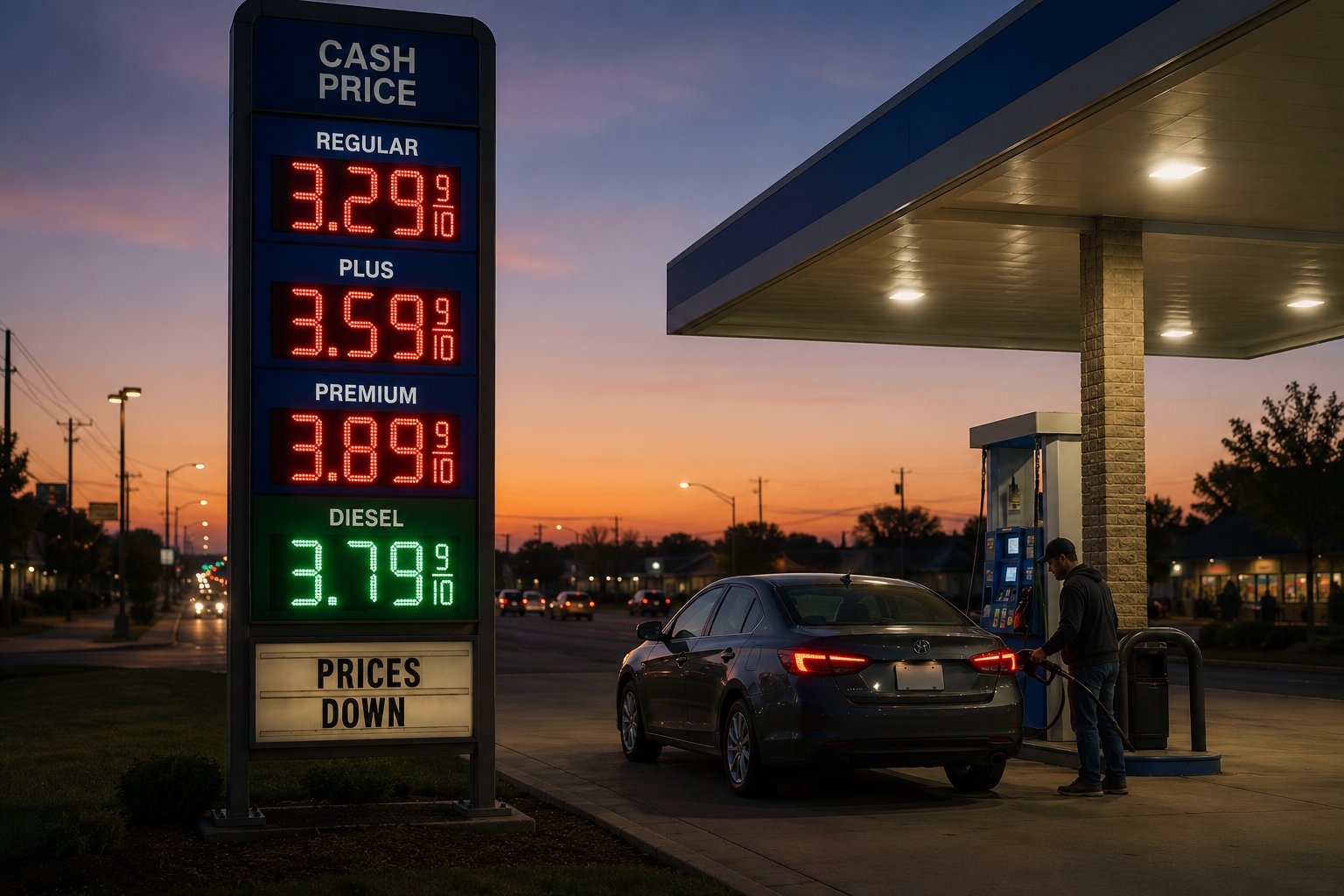
Compare that with gasoline, where the product in the pump is the refined crude, the wholesale price is repriced continuously, and station margins are thin enough that pass-through happens within days. We cover that mechanism in how gasoline prices are set, and the contrast is the whole answer to this question.
When Crude Does Show Up
None of this means the link is imaginary. It means it is slow and it is indirect.
A sustained move in crude, held for quarters rather than days, works through refinery margins into base oil contract prices, then into the price the distributor charges the shop, then eventually onto the menu board. By the time it arrives it has been smoothed, delayed and mixed with unrelated cost pressure from labour and additives.
There is also a second channel most people miss, and in a year like this one it is likely the larger of the two. A crude shock that raises fuel prices raises the cost of the trucking that delivers the oil, the freight that moves the additives, and the disposal contractor who collects the waste. That reaches the shop's cost base faster than the base-oil contract does, and it is not visible as an oil-price effect at all.
The Rule Worth Keeping
If you want to know whether a headline oil price will affect something you buy, ask how much of the finished thing is crude, and how often the seller reprices.
Gasoline is mostly crude and reprices daily, so it moves. Diesel is mostly crude but has its own supply constraints, which is why it can diverge from gasoline for reasons that have nothing to do with Brent, covered in why diesel costs more than gasoline. An oil change is a small amount of a specialty product wrapped in a large amount of labour, priced off a menu, so it barely moves at all.
That question, what is actually in the number and how it is measured, is the same discipline we apply to market data on our reference page on oil data traps. It works just as well on a garage invoice as on a futures contract.
This article is for informational purposes only and does not constitute financial or investment advice. Oil market conditions can change rapidly. Consult a qualified financial professional before making investment decisions.