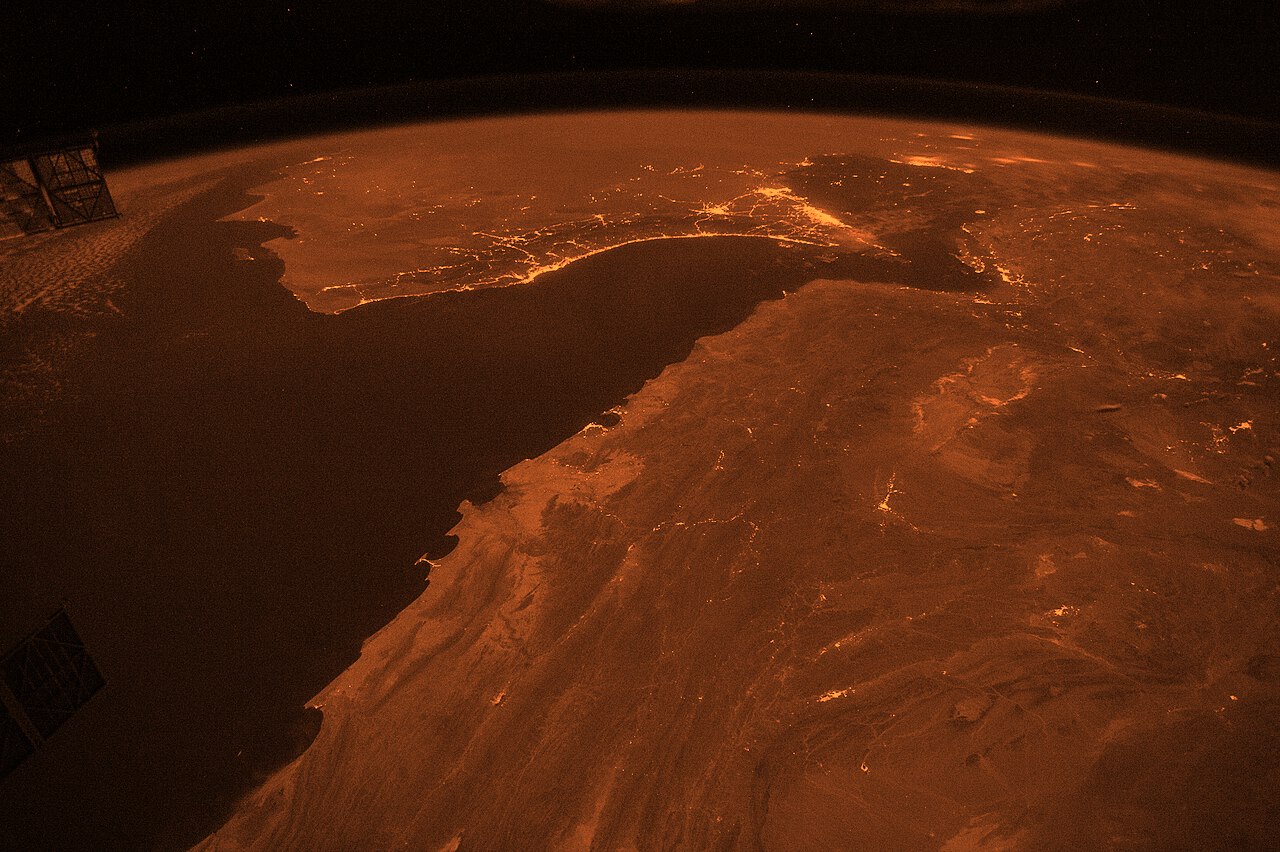
Iran fired roughly 30 missiles and drones at Gulf states at dawn on Wednesday, hitting Kuwait's main international airport and striking at US facilities in Bahrain. One person, an Indian national, was killed at the airport and more than 60 were injured. The barrage came in retaliation for a US strike a day earlier on an Iranian military ground-control station on Qeshm Island. Oil prices, which fell on de-escalation hopes Tuesday, reversed sharply: Brent crude climbed back toward $100 and WTI traded back above $95, a third straight session of gains, reinforced by a large US crude inventory draw.
For weeks this market has treated each escalation as a condition rather than an emergency, and prices fell on every diplomatic signal. A deadly ballistic missile strike on a Gulf capital's civilian airport is a different category of event. The desensitization broke.
What Iran Hit
Kuwait's Defence Ministry said it detected roughly 30 ballistic missiles and drones inbound at dawn, reported as 13 ballistic missiles and 17 drones. A drone struck Kuwait International Airport, causing severe damage and temporarily freezing all activity. Kuwait Airways resumed flights later in the day. The casualties, one killed and more than 60 injured, included fractures, head injuries, amputations, and smoke inhalation. The fatality was an Indian national, which adds a diplomatic dimension given India's large labor presence in the Gulf and its position as a major oil importer.
Iran's Revolutionary Guard separately claimed strikes on the US Fifth Fleet headquarters in Bahrain. There is no independent confirmation of damage or casualties there.
The strikes were the stated retaliation for the US action on Qeshm Island, a strategically positioned island near the center of the Strait of Hormuz, on Tuesday. CENTCOM described that strike as a self-defense response to Iranian attacks across the region, with no US personnel harmed.
Why This Crosses a Line
Throughout the conflict, Iran's strikes have mostly stayed within a recognizable envelope: shipping in the strait, US naval assets, military installations. An attack on a Gulf state's primary civilian airport, with civilian deaths, on the territory of a country that is not formally a combatant, is an escalation in kind, not just in degree.
The Gulf reaction reflects that. Kuwait's Defence Ministry called it "heinous Iranian aggression." UAE presidential adviser Anwar Gargash said "no Gulf state should be left to face these attacks alone," a notable statement given the UAE's exit from OPEC in late April and its drift toward a harder line on Iran. The Gulf states are now directly absorbing the cost of the conflict on their own soil, which changes their calculus on both the war and any eventual deal.
It also gives the Bab el-Mandeb threat more weight. Iran and its allies reaffirmed their intent to "completely block" Hormuz and to "activate other fronts, including the Bab el-Mandeb strait," the chokepoint at the southern end of the Red Sea. Reports of that threat drove an intraday oil spike earlier in the session. There is no confirmed Bab el-Mandeb closure or attack yet. It remains a threat. But a Tehran that is firing missiles at Kuwait's airport is a Tehran the market now takes more literally on its other warnings.
The Inventory Draw Reinforced the Move
The price move had a fundamental tailwind as well as a geopolitical one. The EIA reported Wednesday that US commercial crude inventories drew down 8.0 million barrels in the week ending May 29, to 433.7 million barrels, now roughly 3% below the five-year average. That draw was nearly double the forecast and larger than the American Petroleum Institute's 6.75 million barrel estimate the prior day. Gasoline stocks built, but the headline crude number was firmly bullish.
The draw matters because it confirms that demand is absorbing available supply even at elevated prices. With Hormuz still effectively closed since late February and no confirmation that mine clearing has begun, the supply side has no slack. A large draw on top of a closed strait on top of a deadly Gulf escalation is a combination that the market could not keep discounting.
The Diplomatic Track Is Now Fiction and Fact at Once
Trump continued to project an imminent deal even as the missiles flew. He claimed Wednesday that Iran "has agreed not to have a nuclear weapon" and that the Supreme Leader is personally involved. On Truth Social he wrote that "Iran really wants to make a deal" and told Americans to "just sit back and relax, it will all work out well in the end."
Iran's Foreign Ministry said the opposite. Its spokesperson stated flatly that "no negotiations have taken place at this stage on the details of the nuclear issue." That is a direct contradiction of the US president's public account, and it is the same pattern that has defined the past week: Trump narrating progress, Tehran's official channels denying it, and the gap between the two widening rather than closing.
For oil, the contradiction itself is now a source of volatility. When Trump's de-escalation messaging dominates a session, prices fall, as they did Tuesday. When the physical reality of missiles and draws dominates, prices rise, as they did Wednesday. The market is being whipsawed between the narrative and the facts on a near-daily basis.
What to Watch
Three things will set the next move.
Whether the Gulf escalation widens. An Iranian strike that kills civilians at a Kuwaiti airport invites a response, from Kuwait, from the US, or from the broader Gulf bloc Gargash was addressing. If this becomes a sustained Iran-versus-Gulf-states confrontation rather than an Iran-versus-US one, the risk premium expands well beyond where it has been.
Bab el-Mandeb. Any actual move against Red Sea shipping, as opposed to the threat of one, would add a second chokepoint to the supply disruption and push Brent decisively through $100.
OPEC+ on June 7, now four days away. The group meets into the sharpest escalation of the conflict to date. The case for pausing further output increases and citing instability is now stronger than it was a week ago. With the UAE outside the group and Gulf members under direct attack, the meeting's politics are as fraught as its economics.
The market spent the week betting the conflict was winding down. Wednesday it was reminded that it is not.
This article is for informational purposes only and does not constitute financial or investment advice. Oil market conditions can change rapidly. Consult a qualified financial professional before making investment decisions.