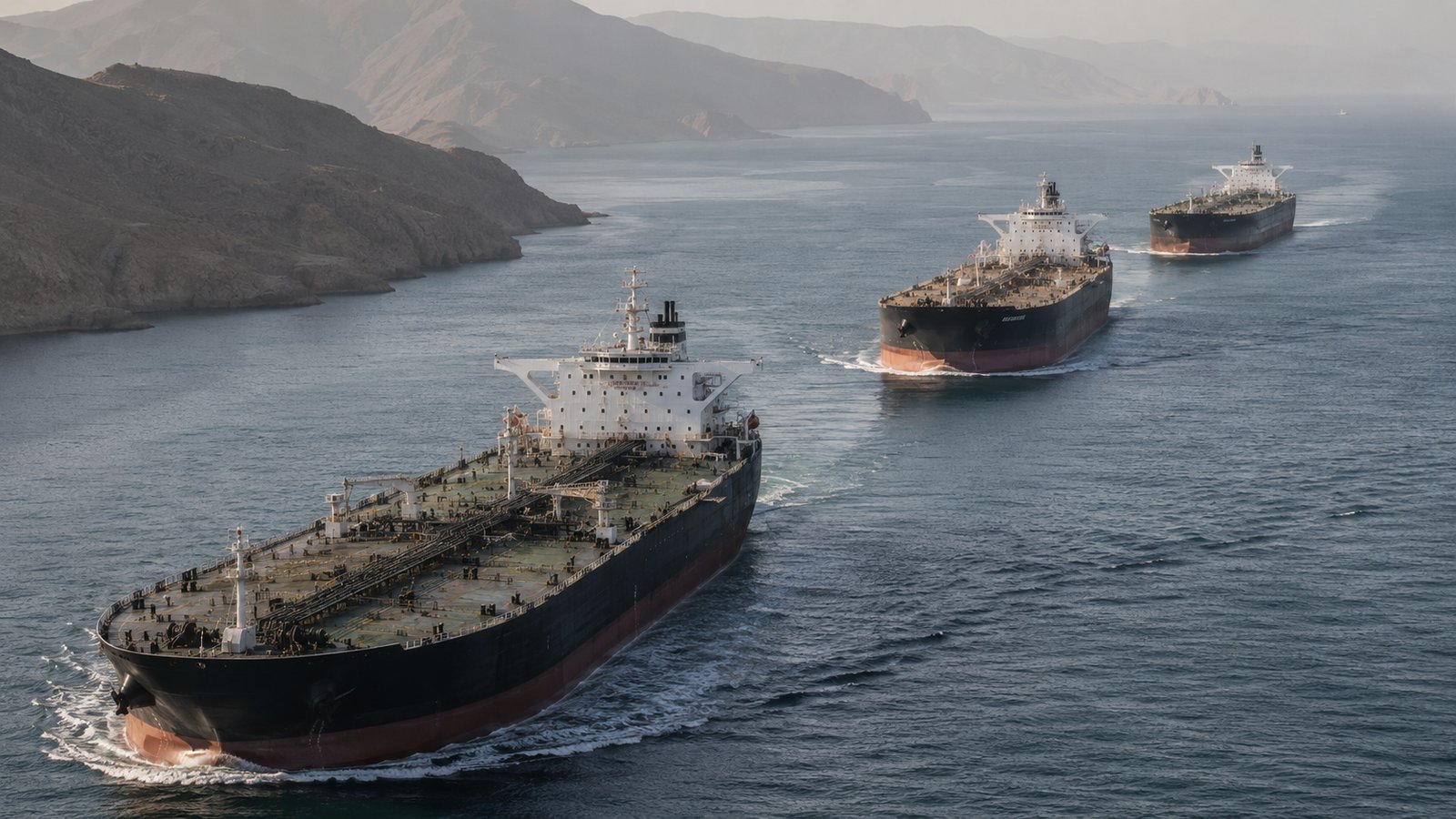
For four months, the words "Iran has closed the Strait of Hormuz" were worth $40 a barrel. On Saturday Iran said them again, and oil fell. That inversion is the whole story of the weekend, and it tells you more about where this market sits than any single price print.
Iran's armed forces declared the strait closed on June 20, calling Washington's failure to restrain Israel's operations in Lebanon a breach of the framework signed at Versailles. They framed it as "the first step" and threatened more. Within hours, Iran's own foreign ministry contradicted its own military, saying shipping was "operating normally." The tankers agreed with the foreign ministry. By Monday, WTI was trading around $76 and Brent near $79, both lower on the day. The market read the most powerful threat in the oil world as bluster, and priced the thing it actually cared about: the talks moving forward.
The Closure That Wasn't
The test of a blockade is whether ships stop. They did not. US Central Command said flatly that "Iran does not control the Strait of Hormuz" and that traffic continued to flow, counting 55 transits on June 21, more than double the figure from earlier in the week. Vice President JD Vance went further, touting "record-breaking" flow through the strait and saying there was "no evidence the Iranians are still closing down" the waterway.
The picture was not seamless. Maritime intelligence firms reported that some operators paused or slowed over the weekend, and war-risk insurance remains expensive, running into the low tens of millions of dollars for a single high-risk voyage. But there was no re-blockade. No mines were laid, no tankers were seized, and the US Navy that has controlled the water since February did not move. Iran issued a declaration. It did not, and at this point largely cannot, enforce one against a US naval presence and a market that has already signed off on reopening.
This is what a spent deterrent looks like. The closure threat worked when closure was credible and the premium was unbuilt. With the strait already reopening under American escort and a framework signed, the same words no longer move the price the same way. The risk premium that the threat used to command has been spent, and a statement cannot rebuild it on its own.
The Talks Happened, and Produced a Road Map
The bigger news ran the other direction. The negotiating session that slipped on Friday went ahead over the weekend in Switzerland. By Monday the mediators, Qatar and Pakistan, announced a "road map" toward a final deal within the 60-day window, with technical talks to begin immediately. Vance called Sunday "a very, very good day" and cited "great progress."
Three concrete things came out of it. Iran agreed to readmit IAEA inspectors to verify compliance. The two sides agreed to stand up a de-confliction arrangement over Lebanon, aimed squarely at the trigger Iran had used to justify the closure. And they set up a direct line of communication to avoid incidents in the strait itself. Iranian Foreign Minister Araghchi also said sanctions on Iran's oil had been waived and some frozen assets released, though that is Iran's characterization and the amounts were not specified.
None of this is a final deal. The hard questions, the permanent status of the strait, whether Iran charges tolls after the 60-day free-passage window, the sequencing of sanctions relief, are exactly what the technical phase now has to resolve. But the direction of travel is toward more Iranian oil reaching the market, not less. For prices, a road map to a final settlement is a bearish document.
Lebanon Held
The fragile piece held. The Israel-Hezbollah ceasefire renewed on Friday survived the weekend, which the previous version of this truce did not. Prime Minister Netanyahu and Defense Minister Katz ordered the military to hold fire across Lebanon on June 21, with the exception of one contested hilltop where clashes continued. Hezbollah did not strike Israeli territory after the renewal. Israel's Home Front Command lifted the civilian restrictions on northern border communities, a concrete signal that Israel itself assessed the truce as holding.
It is not durable. Israeli officials are explicitly keeping forces at high readiness, and the next round of the separate Israel-Lebanon track is expected this week. But the fuse that re-closed the strait on paper did not detonate the deal in practice. The de-confliction cell agreed in Switzerland exists precisely so that the next Lebanese flare-up does not give Iran a reason, or a pretext, to walk.
What It Means for Prices
The setup is now clearly bearish with a single sharp tail. On the bearish side: the strait is moving oil, the talks are advancing toward a final deal, sanctions relief is on the table, and the IEA is warning of a glut as demand growth lags. Monday's decline came from that side of the ledger, with peace progress pulling prices down toward the bottom of their recent range.
The tail risk is what is keeping the floor in place. The mines are still in the water, full normal throughput is still months away, and the 60-day talks can still fail. Saturday demonstrated that Iran will reach for the closure card under pressure, even if the market no longer flinches at it. A genuine breakdown, as opposed to a declaration, would still rebuild a premium from nothing, and it would do so fast because the premium is now zero.
For the moment, the weekend resolved the way the bulls feared and the consumers hoped. Iran played its strongest card, the tankers kept sailing, the diplomats kept talking, and oil drifted lower. The next move belongs to the technical talks, and to the first minesweeper that actually starts clearing the channel.
This article is for informational purposes only and does not constitute financial or investment advice. Oil market conditions can change rapidly. Consult a qualified financial professional before making investment decisions.