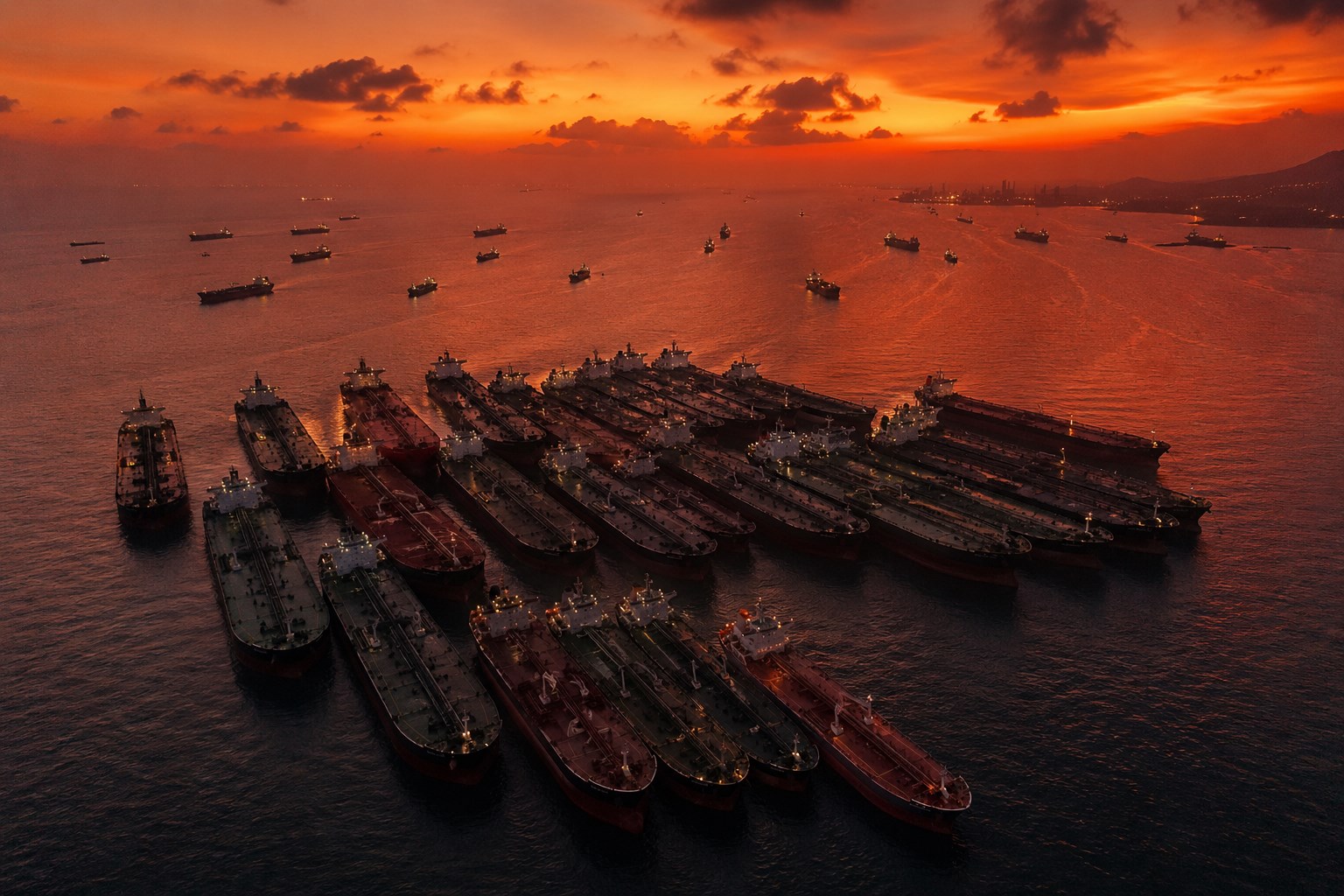
For a week this market has argued about how much oil is leaving the Strait of Hormuz. The weekend produced a number that ends the argument, at least for two days. On Sunday, nothing went through it at all.
Brent rose as much as 1% in Asian trading to $89.40, then faded through the European morning. By late morning Eastern it was near $88.50, effectively unchanged on the day, with WTI near $81.60 after touching $82.82. Both contracts gained more than 5% last week.
The fade is now the most reliable pattern in this market. Every escalation headline for the past two weeks has moved the price on the open and been sold into before New York lunch.
The Deadline Expired, and the Negotiations It Required Never Started
The United States and Iran signed a memorandum of understanding on 18 June. It gave both sides 60 days to negotiate a wider peace deal. Iran was to reopen the strait and forswear nuclear weapons. Washington was to lift the naval blockade and ease sanctions.
Those 60 days ran out today.
Iran's account of why nothing happened is blunt. Its foreign ministry spokesman said Tehran never began negotiating at all, because "the United States began violating the memorandum shortly after its June 18 signing."
Trump's account is that he is in no rush. He said he has "no time schedule" for ending the war and is "not in a hurry."
The war has now run 24 weeks. Whatever the memorandum was, it is now expired, and neither government is describing a replacement.
Zero
Kpler counted five commodity vessels through the strait on Saturday and none on Sunday.
The prior weekend was 31. Before the war began on 28 February, more than 130 ships a day made the transit, carrying about a fifth of the world's seaborne crude and liquefied natural gas.
The composition of Saturday's five is worth reading. One was an empty very large crude carrier running with its transponder switched off. One was an Indian-flagged very large gas carrier using the Iranian route. One was a small tanker carrying Iranian fuel oil, and it was leaving. That is not a waterway operating at reduced capacity. That is a waterway with almost nothing in it.
We spent Thursday's article on the gap between Energy Secretary Chris Wright's claim of almost 9 million barrels a day leaving the strait and the 4 to 7 million the tanker trackers could see. We said the disagreement could not be settled from public data, because Wright's figure included ships running dark and trackers cannot count those.
That is still true as a matter of method. But a seven-day average of 9 million barrels a day cannot survive a weekend of five transits and then zero, whatever the dark rate. The claim was made on Tuesday. By Sunday the visible market had gone to nothing.
Why Nothing Is Moving
The mechanism is not diplomatic. It is that ships are being hit.
The United Arab Emirates said three vessels operated by Abu Dhabi National Oil Company were attacked in transit last week. Two were struck on Thursday evening. A third was hit on Friday evening and reported on Saturday. No one was injured in those particular attacks.
ADNOC says 15 of its vessels have been attacked while transiting the strait since the war began in February. That is one company's fleet.
The UAE foreign ministry condemned "the hostile Iranian attack that targeted two vessels affiliated with ADNOC as they transited the Strait of Hormuz," calling it piracy and a direct threat to regional stability. Iran did not immediately respond to the accusation.
A gap in our own coverage. Two ADNOC vessels were attacked on Thursday evening. We published Friday morning and did not mention it. We led that piece on what Hegseth and Bessent had said about the blockade, which was the right story, but the reason the price was up 4% on the week was sitting in the shipping wires and we did not have it. Statements from podiums are easier to find than attacks on ships. That is a bias worth naming, because it points the wrong way in a war fought against shipping.
Aramco Stopped Allocating
On Friday we said Saudi Aramco's September allocations to Asian refiners were four days overdue and had not been published, and that the split between loading inside the strait and outside it would be the hardest available signal of what refiners actually expect.
The answer arrived, and it is more revealing than either outcome we described. Aramco is not running a normal allocation round at all.
Reuters reported that Aramco is handling September allocations for some Asian term customers on an ad hoc basis, negotiating individual cargoes rather than issuing the usual monthly notice. Four Chinese buyers said they had not received allocations. Under the normal process, buyers nominate volumes after the official selling prices are published and Aramco confirms allocations around the 10th of the month.
The reason is the same one the transit data shows. Few shipowners will enter the Strait of Hormuz or the Red Sea to load at Saudi Arabia's two main export terminals.
Where refiners did choose, they split by geography, according to reporting published this morning. Japanese and South Korean refiners asked to load from Sidi Kerir, Egypt's Mediterranean terminal, which sits outside both chokepoints. Chinese, Taiwanese and Indian processors were directed to Yanbu on the Red Sea. At least one refiner may skip its monthly allocation entirely rather than pay to route around Africa.
Aramco has cut its Arab Light official selling price to Asia to a six-year low. Saudi Arabia shipped about 4.9 million barrels a day to Asia last year. In July it shipped under 3 million.
That is the signal we asked for. The world's largest exporter has stopped being able to tell its biggest customers what they will get, and the price cut has not fixed it.
We should also say that this was reported on Thursday, before we wrote on Friday that the allocations had not appeared. Our sentence was accurate. It was also incomplete, and the explanation was already on the wires.
Washington Threatened the Mediator
Oman has spent months mediating between Washington and Tehran on passage through the strait. Trump told Fox News on Monday what happens if it gets in the way.
"If Oman gets in the way, we'll bomb the sh*t out of them."
This lands on the same day Iran announced it had reached an understanding with Oman on the transit route, and three days after Trump said he intends to annex the waterway outright. Speaking in Garden City, New York on Friday, he said: "After we finish defeating Iran, which is being very badly defeated, pretty soon I'll be declaring the Hormuz Strait a territory of the United States."
Iran and Oman share jurisdiction over the strait. Legal scholars hold that transit fees on it would breach international law, which protects free passage of commercial shipping.
Tehran's replies were flat. Deputy foreign minister Kazem Gharibabadi said the strait "has been Iranian, is Iranian, and will remain Iranian." A separate deputy foreign minister said it "cannot be taken over by a tweet, nor by an aircraft carrier, nor by issuing a decree."
Iran Says the Map Is Agreed. It Still Says That Is Not the Reopening.
Foreign ministry spokesman Esmaeil Baghaei said Monday that "an understanding has been reached regarding the map of the transit route" with Oman, and that the two sides intend to finalise it as a package: the map plus a joint statement.
The mechanics, as Iran describes them, are that ships would enter through a lane close to Iran and exit through a lane close to Oman, paying no fees or tolls during an interim period.
Then the condition, which has not changed. Baghaei said normal commercial shipping and full security in the strait still depend on an end to what Tehran calls illegal American actions, military threats and the naval blockade.
That is the fourth such statement in twelve days, from three separate arms of the Iranian state, each separating the Oman agreement from the reopening of the waterway. The foreign ministry said it on 5 August. The Revolutionary Guard said it on 8 August. Mohsen Rezaei, who runs the Supreme National Security Council, said it on 11 August. The foreign ministry said it again today, on the day the map was agreed.
A market still trading the Oman deal as the route to reopening is trading against every public statement Iran has made about it.
What Else Landed
Baker Hughes reported on Friday that the US rig count rose five to 593, its highest since March 2025. Oil rigs gained one to 455 and gas rigs rose four to 128. The total is up 10% on the year. American drilling is responding to $88 Brent, slowly, as it always does.
Treasury Secretary Scott Bessent's promised economic measures, which he said would be unlike anything in the history of economic isolation, were due this week. They have not appeared yet.
What to Watch
Whether any ships move today and tomorrow. Two days is a weekend, and weekends are always thinner. If Monday and Tuesday also come in near zero, the shut-in is deeper than the 4.9 million barrels a day the EIA used in the forecast it published last week.
Whether Bessent's measures arrive, and whether they contain anything that is not already in force. Iran is under a naval blockade and thousands of existing sanctions, which is why analysts have met the promise with skepticism.
Whether Oman responds to being threatened by the government whose messages it carries. If Muscat steps back from mediating, the only channel between Washington and Tehran closes with the memorandum that created it already expired.
This article is for informational purposes only and does not constitute financial or investment advice. Oil market conditions can change rapidly. Consult a qualified financial professional before making investment decisions.