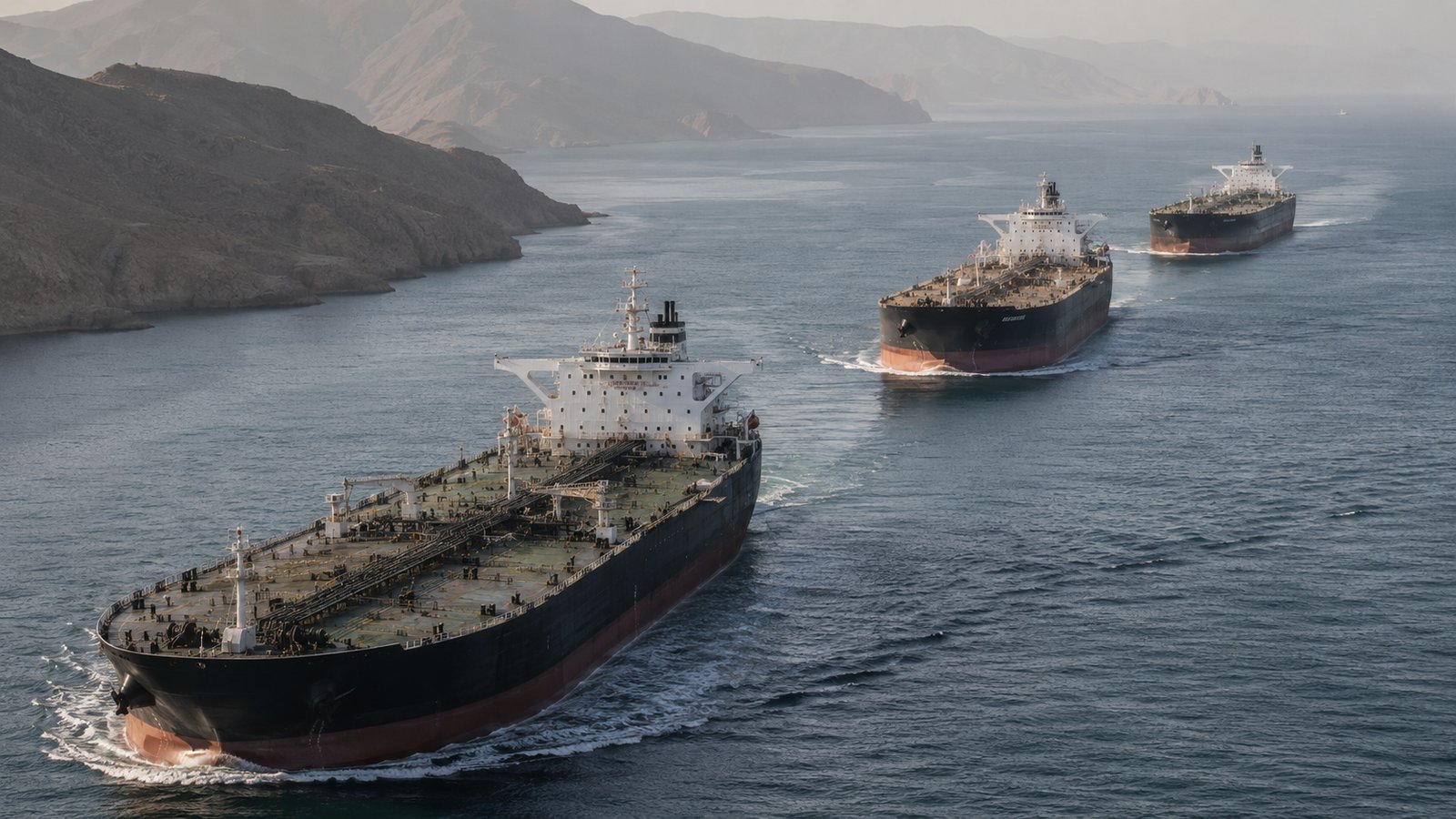
The single most important physical number in the oil market right now is how much crude is actually getting out of the Strait of Hormuz. As of this week, the United States government and the firms that track tankers for a living disagree about it by more than a factor of two.
Brent fell to $87.04 on Thursday morning, down about 2.2%, with WTI at $81.21, down about 2.5%.
The Claim
Energy Secretary Chris Wright said on Tuesday that thanks to the coordinated efforts of the US military and Gulf allies, the seven-day average for oil leaving the Strait of Hormuz was "currently up to almost 9 million barrels per day." He added a further 5 to 7 million barrels a day leaving the region by other routes.
Taken together that is 14 to 16 million barrels a day out of the Middle East, and the administration's framing is that flows have essentially normalised.
The Trackers
Nobody who measures this for money agrees.
JPMorgan puts the figure closer to 4 million barrels a day. Gregory Brew, senior analyst for Iran and oil at the Eurasia Group, says he is seeing a seven-day average around 5 million. The oil market researcher Rory Johnston put last week's seven-day average at a peak of about 7 million. Kpler and LSEG have both produced ranges spanning roughly 1.7 to 7 million.
The EIA's own Short-Term Energy Outlook, published on Tuesday, the same day as Wright's statement, put transits through the strait at 4.9 million barrels a day in the second quarter against 21.6 million in the fourth quarter of 2025.
So the US energy secretary's number sits above every published estimate, including the one his own department released the same day.
Why the Numbers Cannot Be Reconciled
The explanation is not that someone is lying. It is that they are counting different things, and one of those things is invisible by design.
Wright's figure explicitly includes tankers that crossed with their transponders switched off. Tanker trackers, by definition, largely cannot.
Ships in this waterway have been going dark to reduce their exposure to attack, which is a rational response to fifteen vessels being struck since the war began. The automatic identification system that trackers depend on is a safety broadcast, and a captain in a war zone has an obvious reason to stop broadcasting.
That makes the disagreement structurally unresolvable from public data. Wright is asserting a number that includes traffic no independent party can observe, which cannot be checked and cannot be disproved.
What Can Be Checked
The arithmetic on the visible part.
Kpler counted 84 vessel transits through the strait in the whole of last week, including nine on Sunday, against more than a hundred a day before the war.
Nine million barrels a day is 63 million barrels across a week. Spread across 84 transits, that is 750,000 barrels per vessel, and that is if every single one of those 84 were a laden crude tanker. They were not. The count includes bulk carriers, gas carriers and other traffic carrying no crude at all. Restrict it to the crude tankers and the implied cargo per ship rises well beyond what most of them can physically hold.
So Wright's number does not describe the ships anyone can see. It requires a second, unobserved fleet roughly comparable in size to the visible one.
We are not in a position to say that fleet does not exist. We can say precisely what is being claimed, which is more than the claim itself does.
We Wrote the Reference Page for This Argument
This dispute is the fifth item on our reference page on oil data traps, published two weeks ago, and the worked example on that page is this exact waterway.
Kpler found that 40.6% of Strait of Hormuz crossings, 364 of 895, ran with the automatic identification system switched off between 1 March and 19 May this year. That is a measured dark rate for this strait, from the same firm now being cited against the energy secretary.
What it tells you is that both sides of this argument are standing on something real. Tracked volume genuinely is a floor rather than a total, so the trackers' numbers understate reality by some margin. And a dark rate around 40% is large enough to move the estimate substantially, which is why a figure well above the observed one is not automatically absurd.
It is not, however, large enough to close a gap this size on its own, and the middle of the published range is where the evidence actually sits. Brew at 5 million and Johnston at 7 million are the estimates doing the least violence to what can be seen.
The useful posture for a reader is the one we set out on that page. Ask what the number measures, who measured it, and when. On this number, the honest answer to the first question is different for every source quoting it.
What Else Moved
Oman's environment authority said an oil spill from a sanctioned tanker carrying Russian crude has reached beaches at Ras Madrakah, on the country's southern coast. It is a reminder that the sanctioned shadow fleet, the same category of vessel at the centre of the counting dispute, carries risks beyond the ones being argued about in Washington.
Iran's position has not moved. Foreign minister Abbas Araghchi has repeated that the waterway will not reopen until Washington eases sanctions and pays war reparations, which is the same list Iran's security council published on Saturday.
Mohsen Rezaei, who took over that security council on Sunday, has still not spoken publicly in the role. That remains the most informative thing that could happen this week and it has not happened yet.
What to Watch
The EIA's natural gas storage report is due at 10:30am Eastern, after this article goes up.
Saudi Aramco's September allocations to Asian refiners, now several days overdue. Because Aramco asked buyers to nominate from Ras Tanura inside the strait and from Yanbu or Sidi Kerir outside it, the allocation split is a hard measure of what refiners actually expect, made with their own money rather than in a press statement.
And whether anyone reconciles the 9 million barrel figure. If flows really have normalised, tanker trackers will see it within days as ships come back onto their transponders. If they do not, the claim will simply stop being repeated.
This article is for informational purposes only and does not constitute financial or investment advice. Oil market conditions can change rapidly. Consult a qualified financial professional before making investment decisions.