The tit-for-tat that markets feared is now running openly.
Iran's Islamic Revolutionary Guard Corps seized two container ships in the Strait of Hormuz on Thursday and fired on a third. IRGC forces released video of boarding the MSC-Francesca. Hours later, the US Navy confirmed it had seized another Iranian-linked tanker attempting to breach the blockade. Brent crude crossed $103 per barrel — the highest price of the crisis. WTI held above $94 for a fourth consecutive session.
Both sides are now actively seizing commercial vessels. Neither has indicated it will stop.
Iran's Move: Two Ships, One Warning Shot
The IRGC boarded the MSC-Francesca and a second container vessel transiting the strait. A third ship that attempted to pass received warning fire and turned back. Iran released footage of the MSC-Francesca boarding — a deliberate signal that this was not an accident or miscalculation.
Tehran framed the seizures as a direct response to the Touska detention and the ongoing US blockade of Iranian ports. Iran's UN ambassador put the condition plainly: the blockade ends, and talks resume. That position has not shifted since the ceasefire was extended.
The MSC-Francesca is a large container vessel. Its seizure disrupts a major commercial operator and sends a message to every other carrier still considering transit: Hormuz is not safe regardless of what any ceasefire says.
The US Response: Another Tanker Seized
The US Navy seized an additional Iranian-linked tanker on Thursday, the second such action since the Touska detention on Sunday. The pattern is now established: Iran detains ships, the US detains ships, and the commercial shipping community draws the obvious conclusion and stays away.
Combined tanker traffic through the strait has not meaningfully recovered since the crisis began. Insurance underwriters have not revised their war-risk assessments. The extended ceasefire changed the diplomatic calendar. It did not change the physical reality of the waterway.
The Deadlock, Stated Plainly
Iran's position: the US naval blockade of Iranian ports violates the ceasefire and must end before talks resume.
The US position: the blockade remains in place as a negotiating condition and will not be lifted unilaterally.
Both positions are internally consistent. Neither is compatible with the other. The result is a ceasefire that exists on paper and a shooting war over shipping lanes that continues in practice.
An Off-Ramp Appeared Thursday
The Council on Foreign Relations published a proposal Thursday that cuts through the deadlock more cleanly than anything the two governments have offered publicly.
The argument, made by CFR analyst Max Boot, is that both sides decouple Hormuz from the nuclear file entirely. The US agrees to lift its port blockade simultaneously as Iran reopens Hormuz to commercial traffic. Neither side has to move first. Neither side loses face. The mutual nature of the swap is the mechanism that makes it politically viable for both governments.
Boot calls it "Open for Open." Iran's UN ambassador has signalled something similar in recent days, suggesting the framework may have already been discussed through back channels.
The proposal does not resolve the nuclear question, the sanctions regime, or any of the underlying strategic tensions. It resolves exactly one thing: the commercial shipping crisis that is currently removing 17 to 20 million barrels per day from global seaborne supply and driving Brent above $100.
That is not nothing. Rystad Energy's 1 billion barrel cumulative shortfall projection, Goldman's $100-plus full-year Brent call, the EIA's 5.1 million barrel daily draw — all of those numbers shrink materially if the strait reopens, even without a comprehensive deal.
What $103 Brent Means From Here
The market is no longer pricing a near-term resolution as its base case. Thursday's move through $103 reflects the tit-for-tat seizures, the absence of any scheduled talks, and the growing recognition that the ceasefire extension is not a path to an agreement.
If "Open for Open" gains traction — either through direct adoption or through Pakistani mediation — Brent could retrace 15 to 20 dollars quickly. The supply is physically available. The disruption is a choice, not a geological constraint.
If the seizure cycle continues without a diplomatic mechanism to interrupt it, $110 is the next level to watch. Goldman's full-year $100 Brent average already implies prices above that for much of Q2 and Q3.
The proposal is on the table. Whether either government picks it up is a different question.
This article is for informational purposes only and does not constitute financial or investment advice. Oil market conditions can change rapidly. Consult a qualified financial professional before making investment decisions.
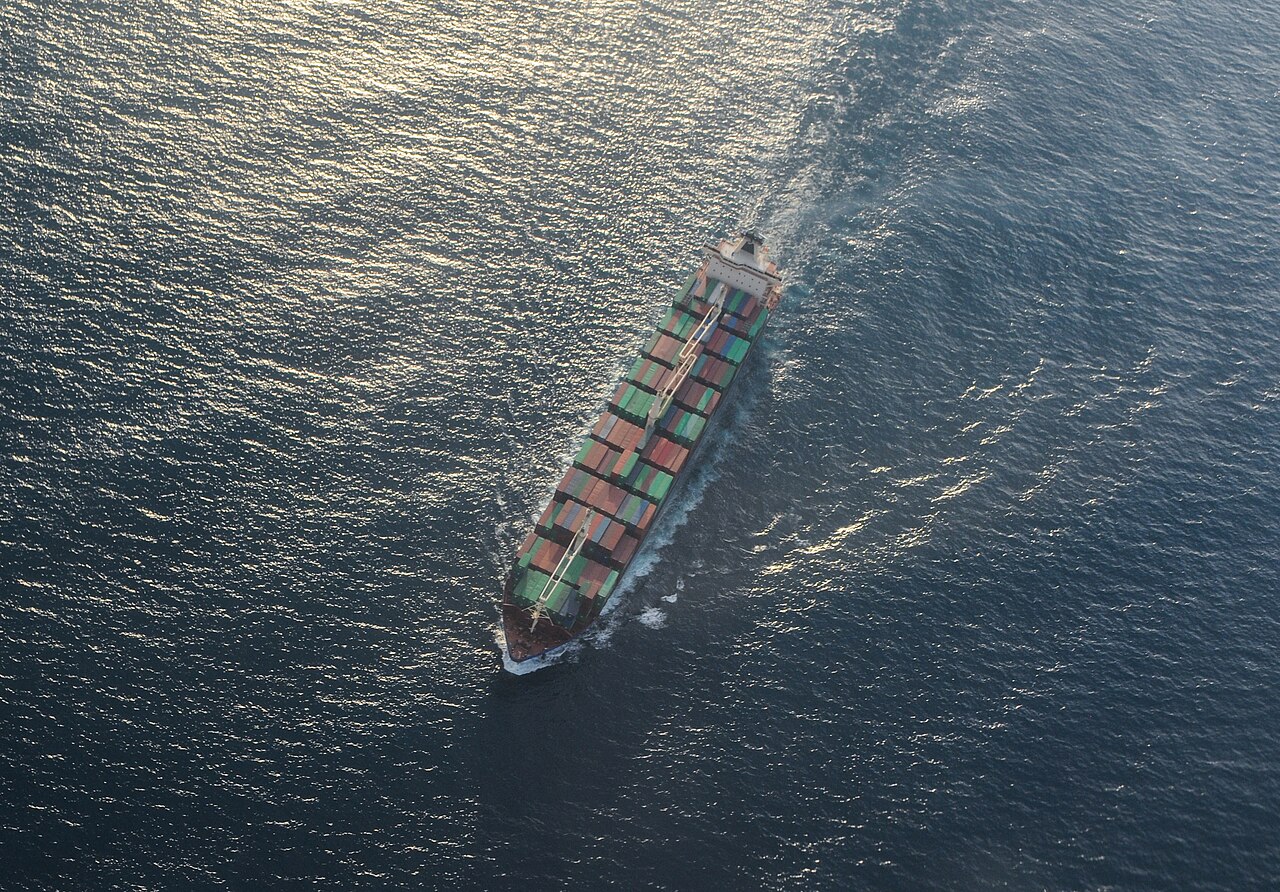
Cover photo: Aerial photograph of a cargo ship in the Caribbean Sea, 2012. Wilfredor / Wikimedia Commons, CC BY-SA 3.0.