Trump landed in Beijing on Wednesday with Elon Musk, Tim Cook, and Jensen Huang accompanying him and declared publicly that the United States does not need China's help to resolve the Iran crisis. OPEC's May monthly report, released the same day, showed global oil production has collapsed by roughly 1.74 million barrels per day in April alone, with the Hormuz blockade now responsible for a supply shortfall that no combination of SPR releases and rerouting can cover.
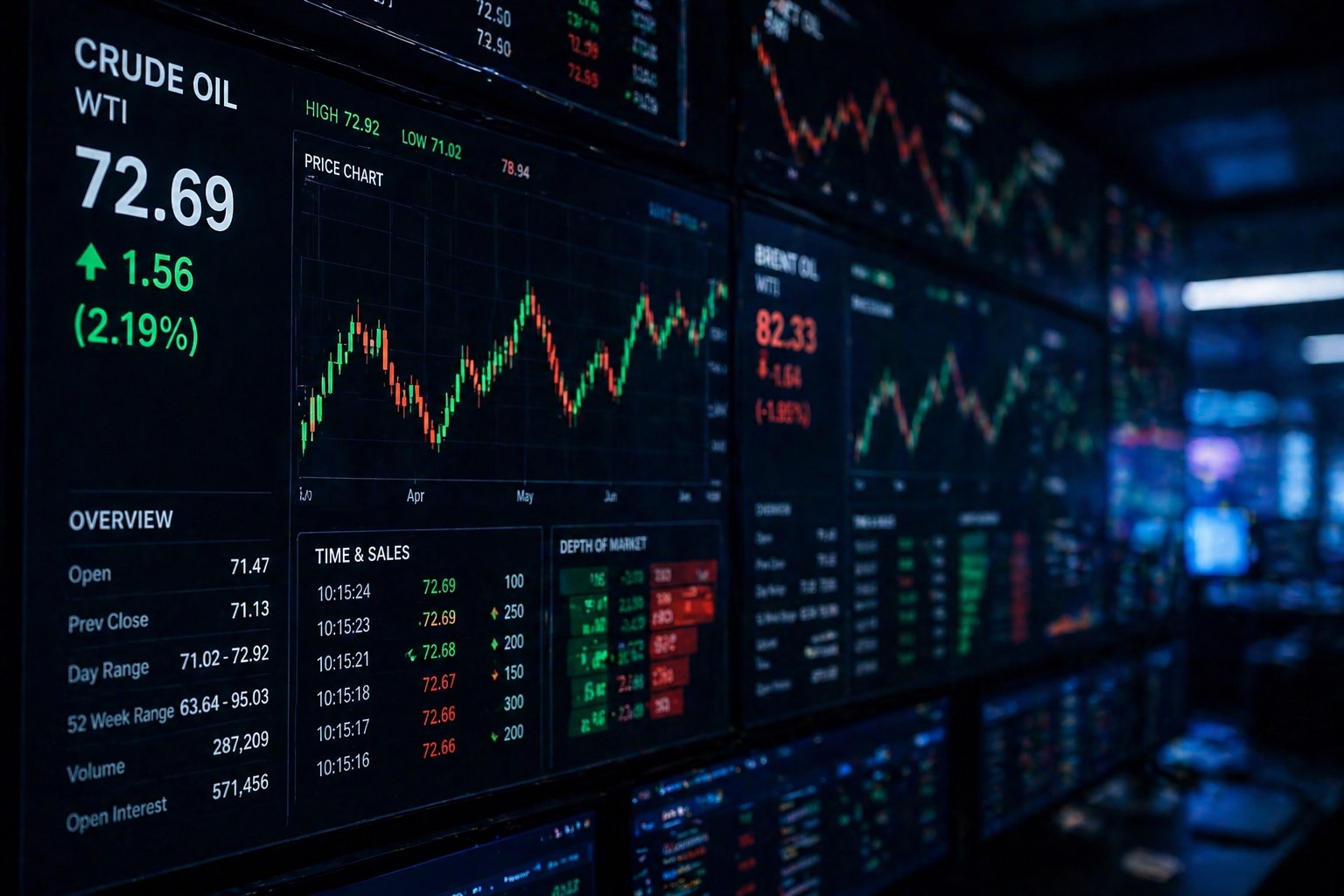
Brent eased 0.7% to around $107 after a 7.6% rally over the prior three sessions. WTI held near $102. The pullback looks like profit-taking ahead of the summit rather than any change in the underlying supply picture.
What the OPEC Report Shows
OPEC output fell to 33.2 million barrels per day in April, down 1.74 million bpd from March. The month-over-month drop reflects Gulf producers losing effective access to export terminals that route through or near Hormuz. Saudi Arabia's nameplate capacity exceeds 12 million barrels per day. Its actual exports are a fraction of that as long as the strait remains largely closed.
The IEA's concurrent data shows observed stockpiles fell roughly 4 million barrels per day in March and April combined. Demand has not dropped proportionally. The gap is being partially covered by the US SPR loan announced Tuesday and by whatever clandestine Hormuz transits are occurring with AIS transponders switched off, but it is not being closed.
OPEC also cut its 2026 oil demand growth forecast to 1.2 million barrels per day from 1.4 million, reflecting broader macroeconomic softness. In normal conditions, a demand downgrade would push prices lower. It is not doing that, because the supply destruction from Hormuz is so large that even weaker demand leaves the market deeply undersupplied.
The Contradiction Trump Brought to Beijing
Trump's public statement that the US does not need China's help on Iran is a negotiating posture, not an analysis. The facts run the other way.
China buys approximately 1.6 million barrels per day from Iran, accounting for roughly 90% of Iran's crude exports. If Beijing reduced those purchases materially, Tehran's primary revenue source would shrink and its leverage in nuclear and ceasefire negotiations would fall. Washington knows this. The 12 sanctions on Chinese entities for facilitating Iranian oil purchases, announced last week, are a direct attempt to use that lever coercively.
Beijing's counter is also clear: China's help on Iran is not free. The Al Jazeera framing going into the summit is that any Chinese pressure on Tehran will require US concessions, most likely on Taiwan, and possibly on the trade tariffs that have been the other dominant issue of Trump's first year back in office. Trump's CEO delegation signals the trade track is the priority he's willing to use as currency.
The summit meetings proper begin Thursday. No agenda has been published. Both governments have positioned the visit as a general reset of a relationship that frayed through early 2026 on tariffs, and they have signaled they want to prevent the Iran question from derailing that reset. Whether those two goals are compatible depends entirely on what Xi asks for and what Trump is willing to give.
What Markets Are Pricing
The mild pullback today reflects a market that ran hard on escalation news and is now waiting to see what Beijing produces before making the next move. Neither Brent at $107 nor WTI at $102 represents a bet on a diplomatic breakthrough. They represent a market that believes the Hormuz closure continues and prices stay elevated, with some reduction in the risk premium while the summit is in session.
The downside case if the summit delivers something concrete on Iran: Brent back toward the low-$100s or high $90s, where deal optimism has previously pushed it. The upside case if the summit collapses or produces nothing on Iran: Brent back toward $110-$111, the top of the post-ceasefire range. The base case is the vague-communique scenario, in which prices drift sideways and the market waits for the next Hormuz headline.
Summit communique language is expected Thursday or Friday.
This article is for informational purposes only and does not constitute financial or investment advice. Oil market conditions can change rapidly. Consult a qualified financial professional before making investment decisions.