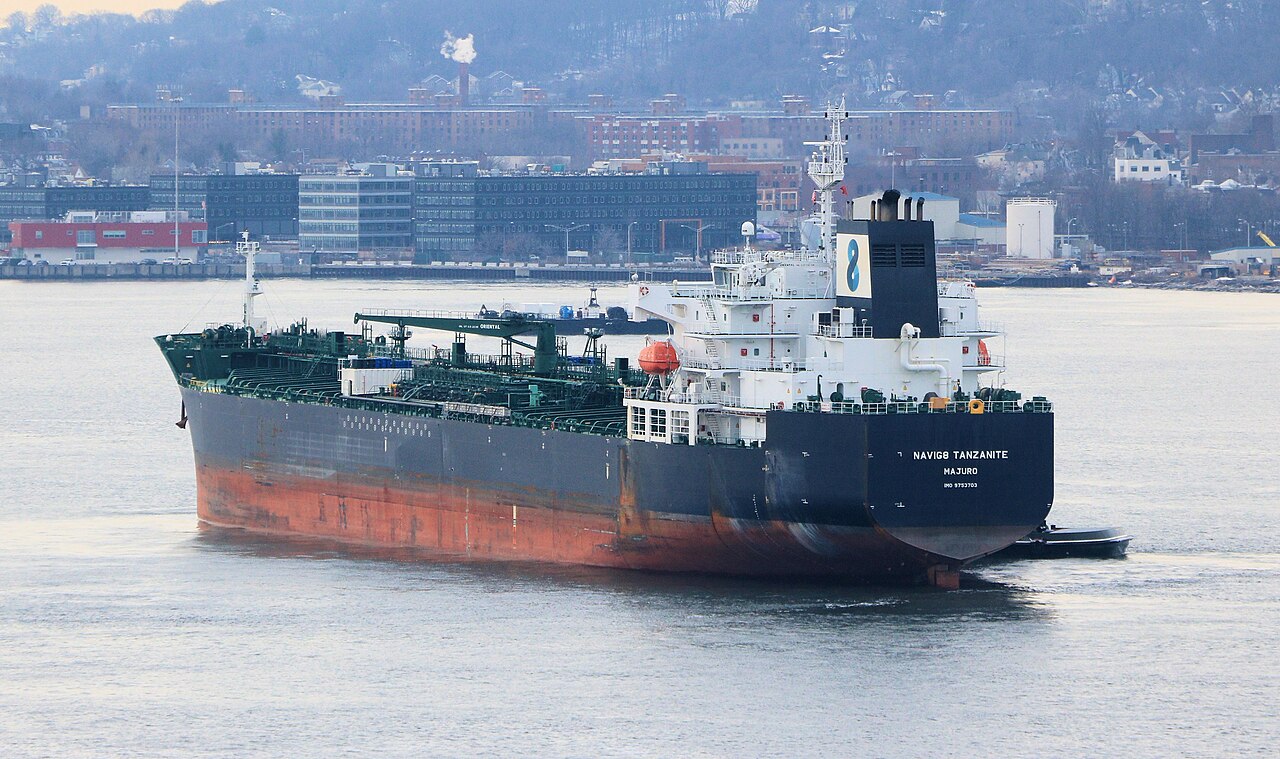
Three supertankers transited the Strait of Hormuz on Thursday, the first material restoration of commercial traffic since the closure began in February. They moved under permits issued by Iran's newly created Persian Gulf Strait Authority, which on the same day formally disclosed a "controlled maritime zone" encompassing the strait. WTI crude settled below $100 on Wednesday for the first time in a week before rebounding modestly Thursday to $99.10. Brent settled at $105.80.
The market is now pricing in a path to partial reopening, but on Iranian terms.
What Iran's New Authority Does
The Persian Gulf Strait Authority's controlled maritime zone runs from Kuh-e Mobarak on the Iranian coast to southern Fujairah on the UAE side as its eastern boundary, and from Qeshm Island to Umm Al Quwain as its western boundary. That polygon covers essentially the entire navigable width of the strait. Transit requires an Iranian-issued permit. The Institute for the Study of War read the framework as a toll system disguised as a maritime insurance scheme.
This is the exact structure the Trump-Xi joint communique of May 15 explicitly opposed. Beijing committed in writing to the position that Iran should not be charging tolls for Hormuz transit. Iran's response, six days later, was to formally establish the institution that issues them.
That China has not publicly objected to the new authority is the more interesting fact. If Beijing's behind-the-scenes pressure is producing results, it is doing so by accommodation, not confrontation.
What Moved the Three Ships
The three supertankers that crossed the strait Thursday were not US-bound or US-flagged. The Iranian permit regime, as currently structured, is workable for Chinese, Indian, and Russian-flagged vessels and unworkable for any US-aligned shipping. That asymmetry is presumably the point: Iran is willing to reopen Hormuz to traffic it prefers while keeping the strait functionally closed to the US naval and commercial presence.
For markets, the immediate effect is bearish. Three tankers is not 100 tankers, but it is the first tangible sign that physical barrels can move again. The IEA's May report estimated global supply down 1.8 million barrels per day in April. If Hormuz partially reopens for non-US shipping over the coming weeks, that gap narrows materially even without a comprehensive deal.
Why WTI Cracked $100 First
Wednesday's price action was the steepest single-day decline of the conflict so far. WTI fell more than 5.6%, breaking below $100 for the first time since the prior week. Brent dropped through $107.
The trigger was Trump's shift from "another big hit" Monday to "negotiations are in the final stages" Tuesday. The phrasing matters. "Final stages" implies the framework of the Witkoff-Kushner-Vance 14-point proposal is close enough to acceptance that further military escalation is being held back rather than scheduled. Trump's Thursday characterization, that there is a "very good chance" of a deal preventing Iranian nuclear weapons, extended the shift.
The 7.8 million barrel EIA inventory draw for the week ended May 15, more than three times the consensus estimate, kept the rebound limited Thursday. Demand is absorbing the available supply at these prices, which counterbalances the deal-optimism move down.
What's Actually Different This Week
Several facts have changed in the last seven days that, taken together, redraw the structural picture.
Iran has stopped escalating shipping incidents in the strait itself. The boarding and tanker seizure pattern that defined late April has paused for the past four days. The Marines boarding of the M/T Celestial Sea on Tuesday was a US-initiated action under the blockade, not an Iranian one.
The Gulf trio of Saudi Arabia, Qatar, and UAE is now an active part of the diplomatic architecture, not a passive recipient of US decisions. The May 18 personal calls from MBS, MBZ, and Sheikh Tamim that pulled Trump back from the strike were the first time those three governments collectively forced a Washington pause on Iran in this conflict.
Bloomberg reported a UAE-Saudi rift earlier this week: UAE failed to get Riyadh to coordinate a joint Iran response. That suggests the Gulf trio is not monolithic. UAE is drifting toward the Israeli camp on Iran policy. That changes the calculus of any deal that depends on Gulf state buy-in.
And the Iraqi attribution of the Barakah drones, confirmed Wednesday, has not been answered with US strikes inside Iraq. The Saudi disclosure that it intercepted three drones from Iraqi airspace earlier this month strengthens that case. Washington is holding the Iraq leverage in reserve, not spending it.
Where Brent Goes From Here
The trading range since the April 8 ceasefire was $97 to $111. Wednesday's close broke the lower end. The range may be repricing downward as the three Hormuz transits prove the closure can soften without a deal.
If Iran's permit regime continues quietly facilitating non-US shipping over the coming weeks, Brent could test $95 even without a signed framework. Physical supply restoration matters more to the price than diplomatic optics.
The upside scenario remains intact. A complete breakdown of the Pakistani-mediated talks, a new Iranian strike against a Gulf state, or US action inside Iraq would each push Brent back above $110. None of those is the base case as of Thursday.
The three tankers are the data point. Everything else is interpretation.
This article is for informational purposes only and does not constitute financial or investment advice. Oil market conditions can change rapidly. Consult a qualified financial professional before making investment decisions.