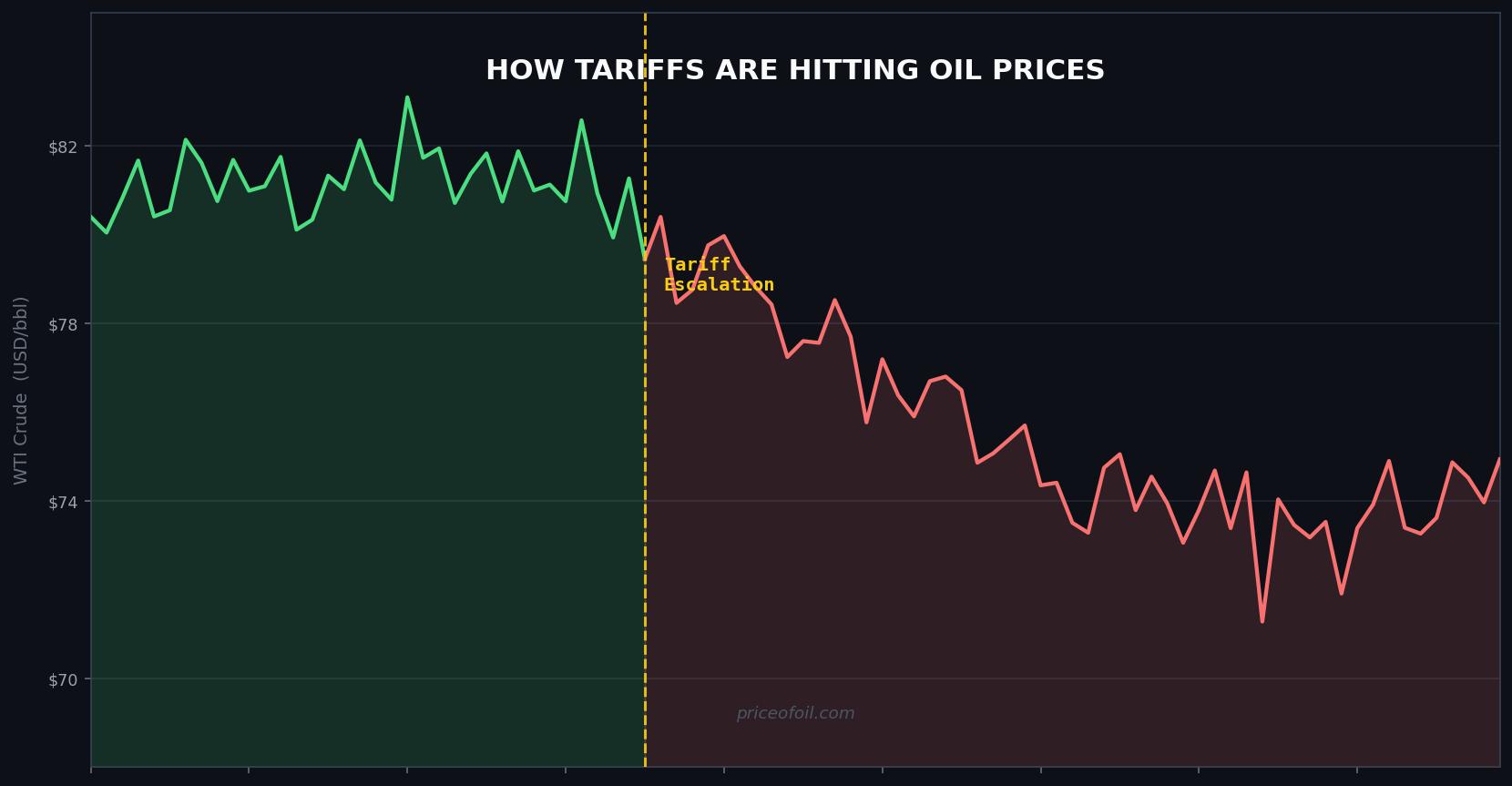
Oil prices have faced renewed pressure in March 2026 as the Trump administration's escalating tariff campaign rattles global trade flows and clouds the demand outlook for crude. WTI has pulled back from its early-year highs, and analysts are revising near-term forecasts downward as recession fears grow in tariff-exposed economies.
Why Tariffs Matter for Oil
Oil is a globally traded commodity priced primarily in U.S. dollars, making it acutely sensitive to shifts in global economic growth. When tariffs slow trade, manufacturing contracts, fewer goods are shipped, and industrial energy consumption falls. The knock-on effect hits crude demand directly.
The current tariff wave, targeting imports from China, Canada, Mexico, and the European Union, is significant enough that major forecasters including the IEA and EIA have already trimmed their 2026 demand growth projections.
The Canada and Mexico Wrinkle
A particularly sharp impact comes from tariffs on Canadian and Mexican crude imports into the United States. Canada alone supplies roughly 4 million barrels per day to U.S. refineries, most of it heavy oil that Gulf Coast refiners are specifically configured to process.
Tariffs on Canadian crude effectively raise the cost of feedstock for American refiners, costs that eventually flow through to gasoline and diesel prices at the pump. In the short term, this creates unusual spread dynamics between WTI (a light, sweet crude) and the heavy Canadian grades that typically trade at a discount.
China Demand: The Bigger Wildcard
The most consequential tariff exposure for oil markets runs through Beijing. China accounts for roughly 16% of global oil consumption, and any meaningful slowdown in Chinese industrial output directly reduces import demand.
Retaliatory tariffs from China on U.S. goods, including agricultural products and LNG, have added a second layer of complexity. Chinese buyers have accelerated purchases of discounted Russian and Iranian barrels, reshaping trade flows in ways that put further pressure on the OPEC+ pricing umbrella.
OPEC+ Caught in the Crossfire
OPEC+ had been planning a gradual unwinding of production cuts through 2026. The tariff-driven demand uncertainty has complicated that calculus significantly. Saudi Arabia and its allies face a difficult choice: hold cuts to defend prices, or increase supply to protect market share as non-OPEC producers (particularly in the U.S. and Guyana) continue to grow output.
The cartel's next ministerial meeting will be closely watched for any signals of a policy pivot. A decision to pause or reverse planned production increases could provide a short-term floor for prices.
What Traders Are Watching
Several indicators are now front-and-center for oil market participants navigating the tariff environment:
- Weekly EIA inventory reports, rising crude stockpiles would signal demand softness
- Chinese manufacturing PMI, a proxy for industrial oil consumption
- U.S.-China trade negotiation headlines, any de-escalation could trigger a sharp rebound
- OPEC+ communications, especially any emergency meetings or informal guidance
- U.S. dollar strength, tariff-driven dollar appreciation makes oil more expensive for non-U.S. buyers, further pressuring demand
Price Outlook Under a Tariff Scenario
If the current tariff regime holds through Q2 2026 without significant de-escalation, most bank commodity desks are targeting WTI in the $65 to $72 range, a step down from the $75 to $80 baseline that had been consensus entering the year. A full-blown global trade recession could test support in the low $60s.
On the upside, any credible trade deal announcement or significant OPEC+ cut extension could reverse the move quickly. Oil markets have a history of sharp, sentiment-driven recoveries.
Bottom Line
Tariffs don't directly tax barrels of oil, but they tax the economic activity that consumes it. The 2026 trade war has introduced a meaningful demand-side headwind that is keeping a lid on crude prices even as geopolitical risks in the Middle East remain elevated. For now, macro uncertainty is winning the battle against supply-side support.
Disclaimer: This analysis is for informational purposes only and does not constitute financial or investment advice. Oil markets are volatile and past performance is not indicative of future results.