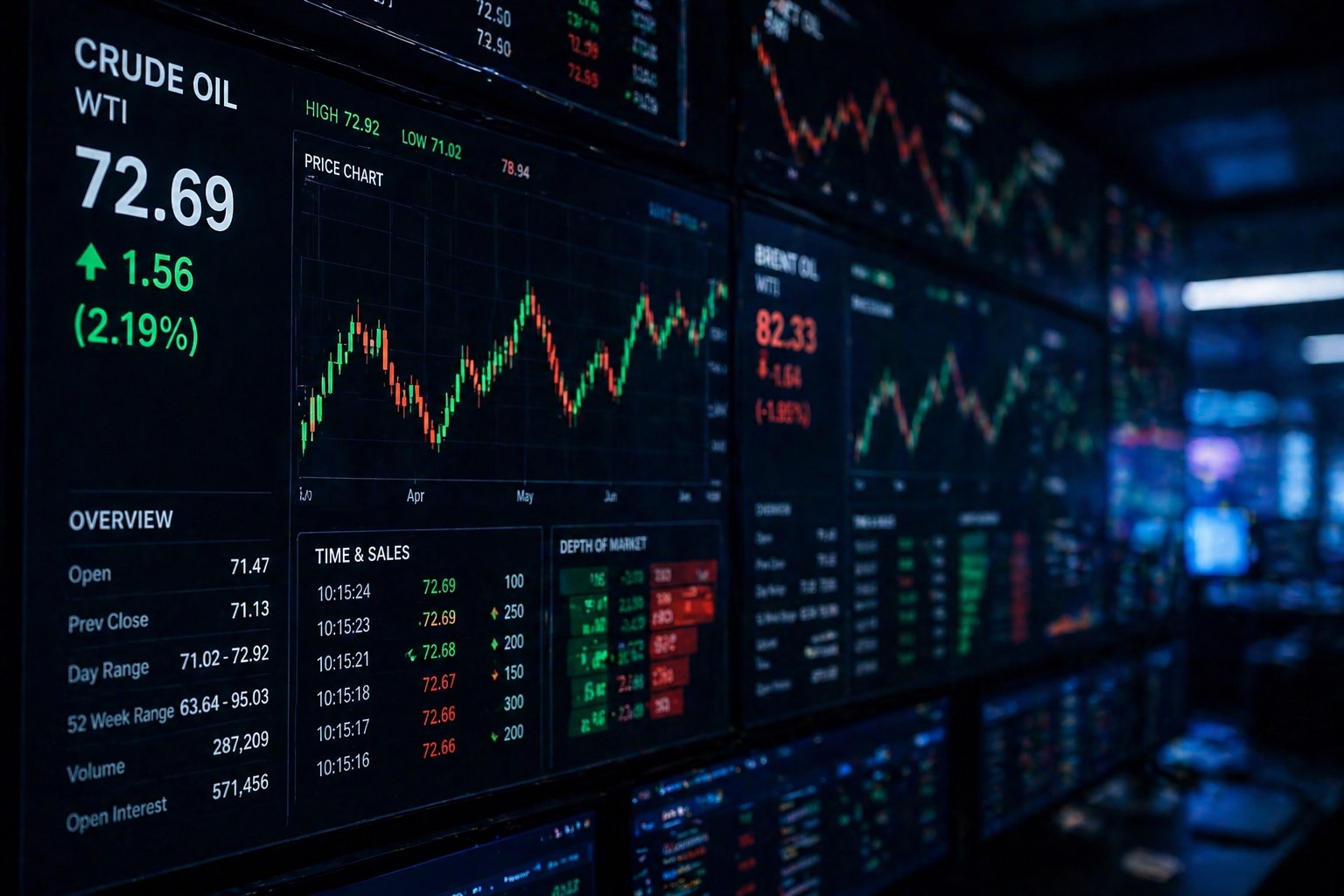
Iran suspended the indirect nuclear talks on Monday, citing Israel's military escalation in Lebanon as a ceasefire violation. Trump, asked about the collapse, said "I don't care" if the negotiations are over, then posted on Truth Social that talks were "continuing, at a rapid pace." Oil prices, which jumped 3 to 4 percent Monday on the weekend's direct US-Iran strikes, reversed and fell. Brent crude traded near $93.80, down 1.2%. WTI fell to about $91.04.
The market did the opposite of what the headline suggests it should have. Iran leaving the table is, on its face, an escalation. But a separate Lebanon ceasefire announced the same day, plus Trump's repeated de-escalation signals, told traders the broader conflict was cooling even as this specific negotiating track broke. Trump put it plainly: oil is "dropping like a rock in the very near distance."
Why Iran Walked
Tehran's stated reason for suspending talks was not the nuclear dispute itself. Iran's foreign ministry, via semi-official Tasnim, said it was halting "talks and the exchange of texts through a mediator" because of Israel's operations in Lebanon, which Iran argues the April 8 ceasefire was supposed to cover. Israel took Beaufort Castle in southern Lebanon on Sunday and Prime Minister Netanyahu threatened Beirut's Dahiyeh district.
The Lebanon trigger matters because it reframes the suspension. Iran did not walk away over the "no dust, no dollars" uranium demand that has defined the talks. It walked away over a different theater entirely, which gives Tehran a path back to the table if the Lebanon situation stabilizes. A partial Hezbollah-Israel ceasefire was announced Monday, with Trump claiming he brokered it through "highly placed Representatives" and that "all shooting will stop." That is precisely the kind of off-ramp that lets a suspension be temporary.
Trump's Two Messages
Trump delivered two contradictory signals within hours of each other, and the market chose which to believe.
In a CNBC interview Monday, he said "I don't care" if the negotiations are over, accused Iran of "stalling for time," and reiterated that the only thing he cares about is that "Iran will not have a nuclear weapon." On Truth Social the same day, he wrote that talks were "continuing, at a rapid pace, with the Islamic Republic of Iran," directly contradicting Tehran's announcement that it had suspended them.
He also introduced a new and complicating demand: that Kuwait, Saudi Arabia, Qatar, and Pakistan join the Abraham Accords as part of any deal. That is a significant expansion of scope. Folding Gulf normalization with Israel into an Iran nuclear-and-Hormuz agreement makes the deal larger, harder, and slower, even as Trump publicly insists it is moving quickly.
The market read the combination, "I don't care" plus "rapid pace" plus a brokered Lebanon ceasefire, as net de-escalation. UBS analyst Giovanni Staunovo was direct: "The social media posts from US President Trump indicating a de-escalation of tensions are weighing on crude prices today."
The Escalation Underneath the Selloff
What makes today unusual is that the price decline is happening over genuine military escalation, not the absence of it.
Iran's Revolutionary Guard claimed the Monday strike on the US base in Kuwait, saying it targeted the airbase that launched a US attack on an Iranian communications tower on Sirik Island. US and Kuwaiti air defenses intercepted two Iranian ballistic missiles, with sirens sounding across Kuwait. No US troops were injured. A container ship, the MSC Sariska V, was struck by a projectile in the Persian Gulf. And the IRGC widened its threat posture, warning it could activate "other fronts, including the Bab el-Mandeb strait," the chokepoint at the southern end of the Red Sea, well beyond Hormuz.
A senior Iranian officer, Mohammad Jafar Assadi, said Tuesday that "war is inevitable" absent surrender, claiming the US "demands our total surrender."
That a container ship was hit, two ballistic missiles were fired at Kuwait, and a senior officer is calling war inevitable, all while oil falls, is the clearest sign yet of how thoroughly the market has habituated to this conflict. The escalation is real. The price response to it is shrinking.
The Physical Picture Still Has Not Changed
As with every recent session, the supply-side reality that would actually move prices durably has not shifted. Hormuz remains effectively closed. The US blockade had turned away roughly 108 vessels since April 13. There is no confirmation that mine clearing has begun. Roughly a fifth of the world's seaborne oil still cannot move through the strait normally.
The IRGC's Bab el-Mandeb threat is worth watching precisely because it points at the one thing that could re-expand the risk premium: a second chokepoint. If Iran or its allies were to disrupt Red Sea shipping in addition to Hormuz, the supply picture would worsen materially and the deal-optimism selloff would reverse hard. For now it is a threat, not an action.
What to Watch
The near-term direction depends on three things.
Whether the Lebanon ceasefire holds. It is the proximate reason Iran suspended talks and the proximate reason oil fell. If it breaks, both reverse.
Whether Iran returns to the table. Because it walked over Lebanon rather than the nuclear core, the path back exists. A resumption signal pushes Brent toward the high $80s. A hardening, or follow-through on the Bab el-Mandeb threat, pushes it back toward $100.
OPEC+ on June 7. The group meets in five days into a market that has fallen 20% from its highs and is now whipsawing on headlines. The cautious path is to pause further output increases and cite instability. With a reported Saudi-UAE rift in the background, the meeting's outcome is genuinely open, and it lands on a market with no stable floor.
Iran left the table and oil fell. That sentence captures how far this market has moved from treating the conflict as an emergency to treating it as a condition.
This article is for informational purposes only and does not constitute financial or investment advice. Oil market conditions can change rapidly. Consult a qualified financial professional before making investment decisions.